
Installing commercial EV chargers can help businesses save money and increase revenue. Lower fueling and maintenance costs, smart charging systems, and government incentives make EV infrastructure a cost-effective choice. Here’s how you can cut expenses and gain financial advantages:
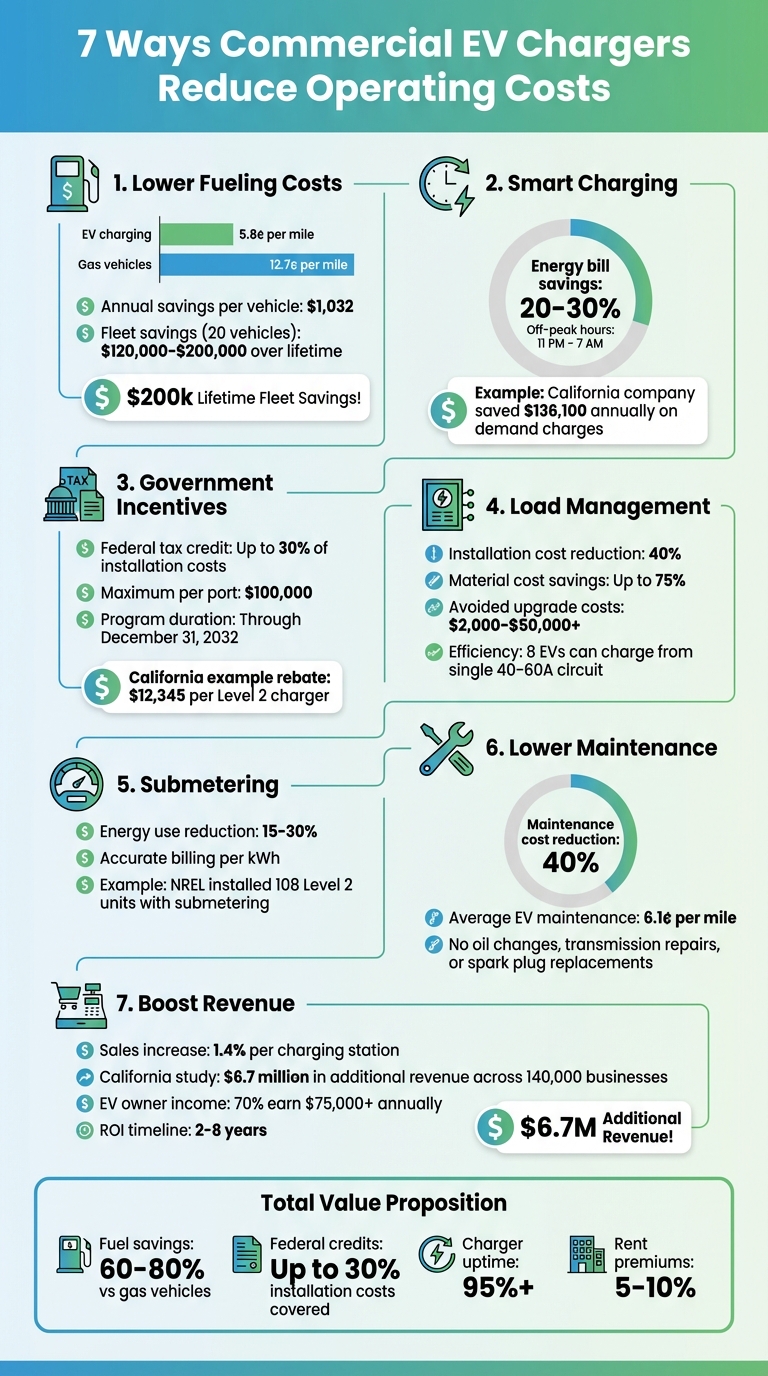
7 Ways Commercial EV Chargers Reduce Operating Costs – Key Savings Breakdown
Switching to electric vehicles (EVs) can significantly reduce fueling expenses. On average, driving an EV costs about 5.8 cents per mile, compared to 12.7 cents per mile for a gasoline-powered vehicle. For a commercial vehicle covering 1,250 miles each month, this translates to approximately $73 in charging costs versus $159 for gasoline. Over a year, that’s a savings of about $1,032 per vehicle. For a fleet of 20 vehicles, these savings could total between $120,000 and $200,000 over the fleet’s lifetime. The savings grow even more when vehicles are charged on-site.
Charging on-site offers even greater cost efficiency. The average household electricity rate in the U.S. is around 17.5 cents per kWh, while public DC fast charging can cost 36.5 cents per kWh or more. In 2022, Chris Centers from San Jose, California, compared the costs of his Rivian R1T to a Jeep Renegade. The Rivian’s energy cost was $0.085 per mile, nearly half of the Jeep’s $0.17 per mile.
Another advantage? Electricity prices tend to be more stable than gas prices, making it easier to plan long-term budgets.
Electricity rates fluctuate throughout the day, primarily based on grid demand. During peak hours – typically from 8 a.m. to 5 p.m. – rates are higher, while off-peak hours, usually between 11 p.m. and 7 a.m., come with lower costs due to decreased demand .
Smart charging systems take advantage of these lower off-peak rates by automatically scheduling EV charging during these times. By syncing with utility rates and tracking Time-of-Use schedules, these systems ensure vehicles are charged efficiently – ready to go by morning – all while avoiding the premium costs of peak hours. This approach can lead to energy bill savings of 20% to 30% for fleets.
“By avoiding peak demand periods, fleets can cut their energy bills by a substantial margin. In some cases, this can reduce charging costs by 20–30%.” – Cox Automotive Insight Team
Beyond saving on rates, commercial electricity bills often include demand charges, which are fees based on the highest 15-minute interval of power usage during a billing cycle. To illustrate, a company in California saved $136,100 annually on its utility bill by leveraging smart charging to reduce peak demand charges.
Smart charging software also supports load balancing, which prevents excessive power use during any single interval. This not only avoids costly demand charges but also helps businesses maximize their current electrical capacity without needing expensive infrastructure upgrades.
Federal and state programs can significantly reduce the upfront costs of installing commercial EV chargers. One of the most impactful is the Alternative Fuel Vehicle Refueling Property Credit (Section 30C), a federal tax credit available to U.S. businesses through December 31, 2032.
This credit covers 6% of total installation costs, including equipment and labor. For projects that meet prevailing wage and apprenticeship (PWA) requirements, the credit increases to 30%. There’s a cap of $100,000 per individual charging port, so a dual-port station could qualify for up to $200,000 in credits. These federal incentives provide a strong starting point, with additional savings available from state and utility programs.
To qualify, installations must be in eligible census tracts, such as low-income or non-urban areas. Businesses can confirm eligibility using the 30C Tax Credit Eligibility Locator. For tax-exempt entities like non-profits or local governments, the IRS offers a direct payment option through “elective pay”.
Many states and utilities also offer rebates that can be combined with federal incentives. For instance, California’s San Joaquin Valley Air Pollution Control District provides rebates of $12,345 per Level 2 commercial charger, covering up to 50% of project costs. Additionally, utility companies often have “make-ready” programs that fund the electrical infrastructure – like transformers, panels, and conduit – needed to support EV chargers.
When claiming the credit, include costs for charging ports, pedestals, wiring, electrical panels, and labor. Be sure to file IRS Form 8911 for the tax year when the equipment becomes operational.
Adding EV chargers can put a strain on your electrical system, potentially leading to costly upgrades that range from $2,000 to over $50,000. Load management offers a smart way to distribute power and keep these expenses in check.
Dynamic Load Management (DLM) is a system that monitors your real-time power usage and ensures EV chargers only draw power after your primary operations are fully supported. It enforces a “power ceiling”, meaning your total electrical load never exceeds your site’s maximum capacity. This approach allows you to install more charging stations than your electrical panel would typically handle.
“Our solution allows businesses and municipalities to not only save on installation costs but also optimize energy consumption. This makes EV charging more efficient and accessible.” – Nick Zamanov, Head of Sales and Business Development, CyberSwitching
Using dynamic load management can significantly lower costs. Businesses adopting this technology can cut installation expenses by 40% compared to traditional grid upgrades. Additionally, material costs for infrastructure can drop by up to 75% with the use of management controllers. Some systems even enable up to 8 EVs to charge from a single 40-60A branch circuit, using rotational charging to alternate power between vehicles.
To determine if load management can replace costly transformer upgrades, conducting an energy audit is a practical first step. This approach not only reduces upfront installation costs but also lays the groundwork for ongoing savings, which will be explored further in the next section.
Once load management strategies are in place to reduce upgrade expenses, submetering steps in to offer precise monitoring and ensure energy costs are recovered for every charging session.
Submetering systems measure the exact amount of energy used for EV charging, making billing more accurate. Installed downstream of the utility’s master meter, these devices track the energy consumed by each charging unit with precision. Revenue-grade submeters are particularly valuable because they ensure users are billed fairly based on the electricity they actually consume.
Modern submetering systems often integrate with networked platforms, using tools like RFID, mobile apps, or credit card readers to connect each charging session to a specific user account. These systems automatically upload data to cloud platforms via OCPP, eliminating the need for manual readings and simplifying the billing process. This level of accuracy supports not only fair billing but also helps businesses implement energy-saving measures.
“Using revenue-grade submeters will allow landlords to bill each tenant accurately by measuring how much actual electricity they use.” – Byram Labs
Submetering doesn’t just handle billing – it also encourages energy conservation. By allowing users to monitor their consumption, it can reduce energy use by 15–30%. Businesses can also adopt flexible billing structures, charging users by kilowatt-hour (kWh), session duration, time of day, or even through subscription plans.
For multi-tenant properties, submetering separates EV charging energy from the building’s overall usage, which helps maintain energy performance ratings. A great example comes from the National Renewable Energy Laboratory (NREL), which installed 108 Level 2 charging units equipped with submetering to track usage. This approach minimized the need for costly electrical infrastructure upgrades.
In addition to saving on fuel and electricity, electric vehicles (EVs) come with another big perk: lower maintenance costs. Unlike traditional internal combustion engine (ICE) vehicles, which have hundreds of moving parts working at high speeds, EVs are far simpler. This streamlined design means fewer things that can break down, resulting in less frequent repairs and lower service costs for fleet operators.
With EVs, you can say goodbye to oil changes, transmission fluid checks, spark plug replacements, and exhaust system repairs. Plus, regenerative braking – a system that uses the electric motor to slow the vehicle while recharging the battery – takes much of the strain off the brakes. This not only extends the life of brake components but also reduces the need for costly brake repairs, a common issue with gas-powered vehicles that rely entirely on mechanical braking.
The savings can be impressive. Take the F-150 Lightning, for example. Over eight years or 100,000 miles, its maintenance costs are 40% lower compared to its gasoline-powered counterpart. On average, light-duty EVs cost just 6.1 cents per mile to maintain. These reduced service needs make EVs an even more attractive option for cutting overall operating expenses.
However, there are a few trade-offs. EVs are heavier than comparable gas vehicles – by anywhere from 500 to 2,000 pounds – and their instant torque can lead to faster tire wear. On the bright side, teaching drivers to make better use of regenerative braking can help extend the life of both brakes and tires.
Adding EV chargers to your business can directly boost revenue by increasing how long customers stay and how much they spend. Since charging sessions usually last anywhere from 30 minutes to several hours, customers have plenty of time to shop, dine, or use your services. According to research from MIT, a single EV charging station can generate thousands of dollars per year for nearby businesses. Another study of 140,000 businesses in California found that installing one charging station led to a 1.4% increase in sales, collectively adding up to $6.7 million in additional revenue across those businesses. This revenue boost is even more pronounced because EV chargers tend to attract a higher-income customer base.
EV owners are a desirable demographic. Around 70% of EV drivers earn $75,000 or more annually, 70% hold college degrees, and 65% are over the age of 40. Some specific EV models are especially popular among high-income buyers – for example, Ford Focus Electric owners report an average household income of $199,000, while Fiat 500e owners average $145,000. These customers are not only financially stable but also more likely to spend money while waiting for their vehicles to charge, whether that’s on coffee, shopping, or booking a hotel stay.
Beyond in-store spending, EV chargers can also generate direct revenue. Businesses can charge customers per kilowatt-hour (kWh) or per session. Some even use free or discounted charging as part of loyalty programs to encourage repeat visits, while charging standard rates for one-time customers.
Choosing the right type of charger for your business is key to maximizing both savings and customer satisfaction. Level 2 chargers are ideal for places like hotels, restaurants, and offices, where customers typically stay for longer periods. On the other hand, DC Fast Chargers are better suited for retail centers and convenience stores, where quick stops are the norm. Whichever option you choose, offering EV charging gives your business a competitive advantage. Drivers actively seek out locations with convenient charging options, bringing more customers through your doors.
Investing in commercial EV charging is a smart move that can significantly lower operating costs. EV fleets can slash fueling expenses by 60% to 80% compared to traditional gas-powered vehicles, and federal tax credits can cover up to 30% of installation costs. With features like smart charging systems and load management, businesses can avoid expensive electrical upgrades, while submetering ensures energy costs are tracked and recovered accurately.
Beyond cost savings, EVs require less maintenance, and their growing popularity means installing charging infrastructure keeps your business ahead of consumer expectations. EV charging stations also attract high-income customers who are likely to spend more time – and money – at your location.
When it comes to financial returns, the numbers speak for themselves. Commercial EV charging investments typically pay off in 2 to 8 years. Many businesses see even faster returns when factoring in increased customer traffic, rent premiums of 5% to 10%, and revenue from charging fees. Modern networked chargers, with uptime rates above 95%, ensure reliable service that keeps customers happy and coming back.
Whether you’re managing a fleet, running a retail space, or operating a hospitality business, EV chargers offer a triple win: lower installation costs thanks to incentives, reduced operational expenses through smart energy management, and new revenue streams from customer usage. The question isn’t whether to invest in EV charging – it’s how soon you can get started.
Smart charging systems enable businesses to cut down on electricity expenses by carefully managing when and how electric vehicles (EVs) are charged. By scheduling charging sessions during off-peak hours, when electricity rates are typically lower, companies can sidestep hefty demand charges and avoid paying peak-time premiums. This dynamic approach to energy management allows businesses to benefit from fluctuating utility rates while keeping unnecessary costs in check.
On top of that, smart charging technology optimizes energy distribution, ensuring that electrical systems aren’t overwhelmed. This prevents the need for expensive infrastructure upgrades while maintaining smooth operations. For businesses investing in EV infrastructure, this means lower energy bills and a more efficient, budget-friendly way to support their transition to EVs.
Installing EV chargers offers businesses a chance to draw in EV drivers – many of whom tend to have higher incomes and are more inclined to make purchases while their cars charge. For businesses located near these chargers, this can translate into a boost in sales.
Beyond driving foot traffic, EV chargers also provide a direct revenue stream through charging fees. And with federal and state incentives helping to cover installation costs, businesses can see a solid return on investment while positioning themselves as a go-to choice for environmentally aware customers.
Businesses in the U.S. have access to various government incentives that can significantly cut the costs of installing commercial EV chargers. One of the key options is the federal 30C tax credit, which covers anywhere from 6% to 30% of project costs, capped at $100,000 per charger. Installations in non-urban or low-income areas can qualify for even greater benefits. Another federal incentive, the Alternative Fuel Vehicle Refueling Property Credit, provides a 6% credit on property-related costs.
On top of federal programs, many states and utility companies offer rebates that can offset 30% to 75% of installation expenses. The specific savings depend on the location and details of the program. These incentives help businesses manage upfront costs, making it easier to invest in EV charging infrastructure.