
As electric vehicle adoption continues to accelerate across North America, businesses are increasingly investing in reliable and scalable charging infrastructure. Among the available options, Level-2 EV chargers have become the most practical and widely deployed solution for commercial environments. They offer a balance between charging speed, installation cost, and operational efficiency, making them ideal for workplaces, retail centers, hotels, multi-family buildings, and destination charging locations. In 2026, advancements in smart charging technology, network connectivity, and energy management have further improved the performance and flexibility of Level-2 chargers. This article reviews the top 10 commercial Level-2 EV chargers in North America, highlighting solutions that stand out for reliability, features, and long-term value for businesses.
A Level-2 EV charger is a widely used electric vehicle charging solution that delivers alternating current (AC) power to an EV through a 208–240-volt electrical supply. Unlike Level-1 chargers, which rely on standard household outlets and provide very slow charging speeds, Level-2 chargers significantly reduce charging time while remaining cost-effective and practical for commercial installations.
Most commercial Level-2 chargers operate within a power range of 7 kW to 19.2 kW, allowing electric vehicles to gain approximately 20–60 miles of range per hour, depending on the vehicle and charger capacity. This makes Level-2 charging ideal for locations where vehicles are parked for extended periods, such as office buildings, retail centers, hotels, multi-family residential properties, and workplaces.
Level-2 chargers typically use the J1772 connector, which is compatible with the vast majority of electric vehicles in North America, while Tesla vehicles can charge using adapters or integrated support for emerging standards. Because Level-2 charging places less demand on the electrical grid compared to DC fast charging, installation is generally simpler and more affordable, requiring minimal utility upgrades. As a result, Level-2 EV chargers have become the backbone of commercial EV infrastructure, offering a scalable and reliable solution for meeting growing charging demand.
Level-2 EV chargers offer a practical and cost-effective solution for businesses looking to support electric vehicle drivers while maximizing return on investment. Unlike DC fast chargers, which are best suited for highway corridors or quick top-ups, Level-2 chargers provide efficient, steady charging that aligns perfectly with longer parking durations typical at workplaces, shopping centers, hotels, and residential complexes.
One of the main advantages for commercial operators is lower installation and operational costs. Level-2 chargers draw less power from the electrical grid, often requiring minimal infrastructure upgrades, which reduces upfront investment compared to DC fast charging stations. Their moderate power demand also makes them easier to deploy in multi-unit properties or urban locations without significant disruption.
Another key benefit is scalability. Businesses can install multiple Level-2 units to serve a larger number of vehicles simultaneously, catering to employees, customers, or residents without overloading the system. Many Level-2 chargers also come with networked smart features, such as usage monitoring, scheduling, and billing integration, which allow businesses to manage charging efficiently and even generate revenue from pay-per-use or subscription-based models.
Level-2 chargers also support sustainability and ESG initiatives. By offering accessible EV charging, businesses encourage environmentally friendly transportation choices, reduce carbon footprints, and enhance their corporate responsibility profile. In addition, as EV adoption grows, having Level-2 infrastructure in place ensures that commercial properties remain future-proofed, attracting tenants, employees, and customers who prioritize access to charging facilities.
In summary, Level-2 chargers combine affordability, efficiency, scalability, and sustainability, making them the ideal choice for commercial locations where vehicles are parked for extended periods, while still meeting the growing demand for EV charging across North America.
Level‑2 EV chargers are the backbone of commercial, multifamily, workplace, and hospitality charging. They provide reliable charging for vehicles parked for extended periods, making them ideal for apartments, offices, hotels, and municipal sites. Choosing the right Level‑2 charger involves balancing price, reliability, features, and network support. Here’s a look at the top 10 commercial Level‑2 EV chargers in North America for 2026:
Zerova is a high-quality, premium-priced Level‑2 charger that fits best for fleet and commercial applications. Its hardware is robust and built to last, providing excellent reliability over long-term deployments. The design is straightforward, focusing on build quality rather than additional smart features.
Pros: Premium hardware, highly reliable, excellent durability
Cons: High price, basic design
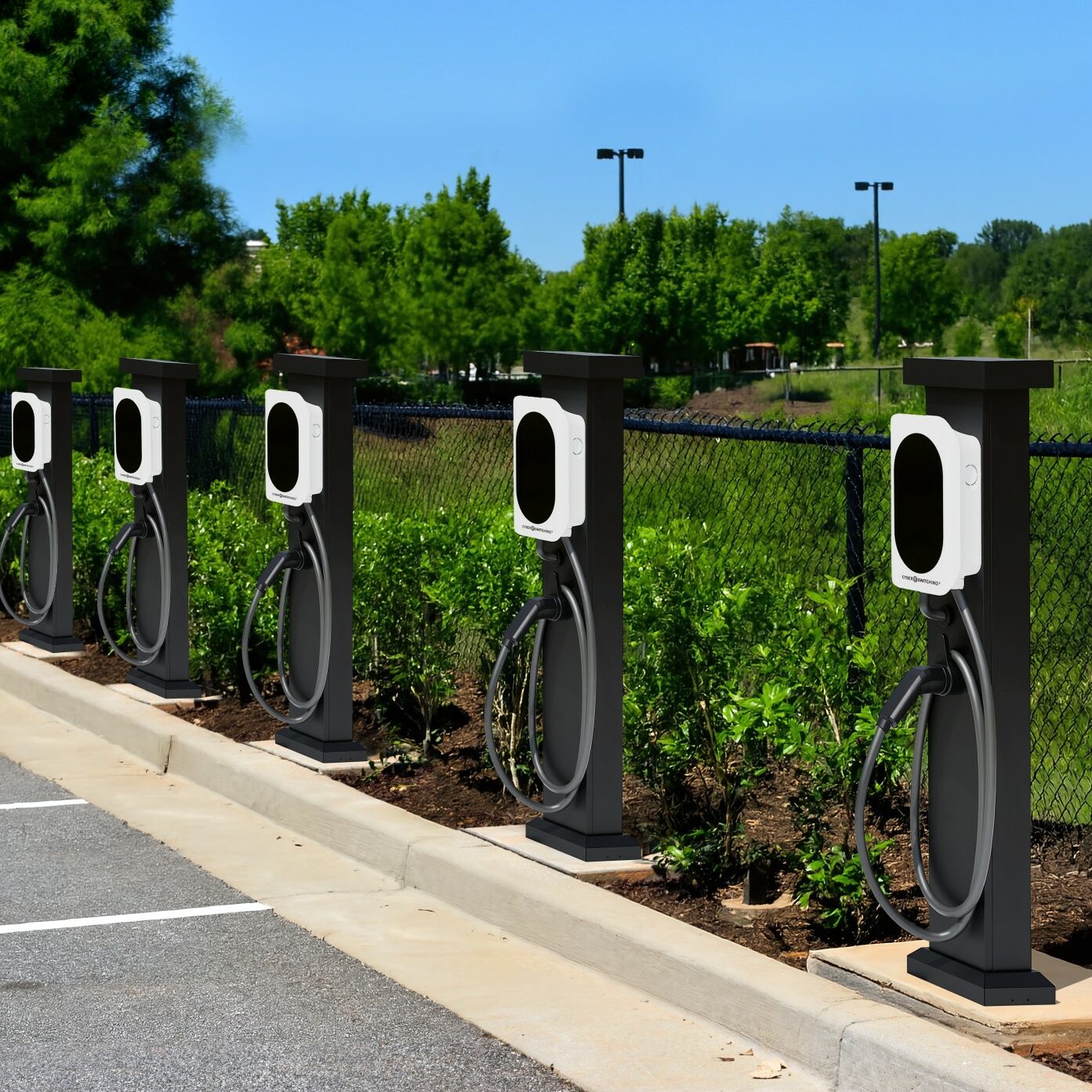
CyberSwitching offers one of the most reliable and simple Level‑2 solutions on the market, priced aggressively. It supports smart load sharing, payment collection, reservations, access limits, and cellular connectivity. The solution is particularly well-suited for multifamily properties, workplaces, hospitality sites, and municipalities. Its simple design makes maintenance easy while still providing the core functionalities needed for commercial deployments.
Pros: Highly reliable, simple maintenance, supports smart features, aggressive pricing
Cons: simple design with less bells and whistles
ChargePoint is widely deployed and networked, offering scalable hardware and a comprehensive management ecosystem. It includes mobile apps, cloud management, and reporting tools, making it suitable for workplaces, multifamily complexes, and public sites. Its strong brand recognition makes it a safe choice for large deployments.
Pros: Scalable, large ecosystem, strong brand recognition
Cons: Expensive, support challenges, closed network
SemaConnect and Blink chargers are flexible and commercial-ready, with strong app and payment integration. They work well in multifamily properties, retail sites, and workplaces requiring user-friendly management, access control, and reporting.
Pros: Flexible, app and payment integration, commercial-ready
Cons: Pricey, occasional connectivity issues, support challenges
FLO chargers are known for reliable performance and a strong presence across North America. They are widely used in apartments, workplaces, and public locations. FLO solutions provide consistent uptime and strong durability.
Pros: Reliable performance, widely deployed
Cons: Expensive, closed network, support varies
Delta’s Level‑2 chargers are industrial-grade and highly durable. They are designed for heavy commercial use, such as fleet depots or high-use workplaces. While dependable, some models have long lead times and may not meet all regional regulations.
Pros: Industrial-grade, durable, reliable
Cons: Long lead times, doesn’t meet all regulations in some areas
Enphase integrates Level‑2 charging with solar energy solutions, making it ideal for properties looking to combine renewable energy and EVSE. Their chargers are energy-efficient and well-suited for multifamily buildings and workplaces seeking sustainability.
Pros: Energy-efficient, solar + EVSE integration
Cons: New solution – less proven, limited functionality, support challenges
Tesla’s proprietary Level‑2 chargers are basic and cost-efficient, designed primarily for Tesla vehicles. They offer simple installation and reliable charging but lack OCPP compliance and advanced management features. They are suitable for Tesla-focused workplaces or residential sites.
Pros: Cost-efficient, simple installation, reliable for Tesla vehicles
Cons: Proprietary, limited functionality, mostly supports Tesla vehicles
LiteOn offers commercial-grade Level‑2 chargers with reliable hardware. They are well-suited for workplaces, multifamily properties, and hospitality environments. Some models may have longer lead times and occasional connectivity issues.
Pros: Commercial-grade, reliable performance
Cons: Lead times, connectivity issues
Siemens produces trusted, industrial-grade EVSE for commercial installations. Their Level‑2 chargers are widely deployed in multifamily buildings, workplaces, and public sites. While reliable, some units have had occasional reliability issues, and the lifetime may be slightly lower compared to other premium brands.
Pros: Industrial-grade, trusted brand, solid reliability
Cons: Some reliability issues, lower lifetime
Selecting the right Level‑2 commercial EV charger depends on your site’s use case, budget, and desired functionality. CyberSwitching stands out for multifamily, workplaces, hospitality sites, and municipalities due to its reliability, smart features, and aggressive pricing. Premium options like Zerova and ChargePoint are strong but come at a higher cost, while Tesla is ideal for Tesla-only deployments.
By weighing pros and cons, commercial buyers can select the charger that fits their site’s unique requirements, ensuring a smooth and reliable EV charging experience for years.