
When choosing EV chargers, the first decision is whether to go for networked or non-networked options. Here’s the quick breakdown:
| Feature | Networked Chargers | Non-networked Chargers |
|---|---|---|
| Internet Connectivity | Yes | No |
| Remote Management | Yes | No |
| Payment Options | Integrated (apps, cards, RFID) | None (usually free to use) |
| Visibility on Maps | Yes | No |
| Cost | Higher upfront and recurring fees | Lower upfront costs |
| Best For | Commercial, public, fleet use | Residential or free charging |
Key takeaway: If you need control, revenue options, and scalability, networked chargers are worth the investment. For simpler, cost-effective setups, non-networked chargers are a better fit.
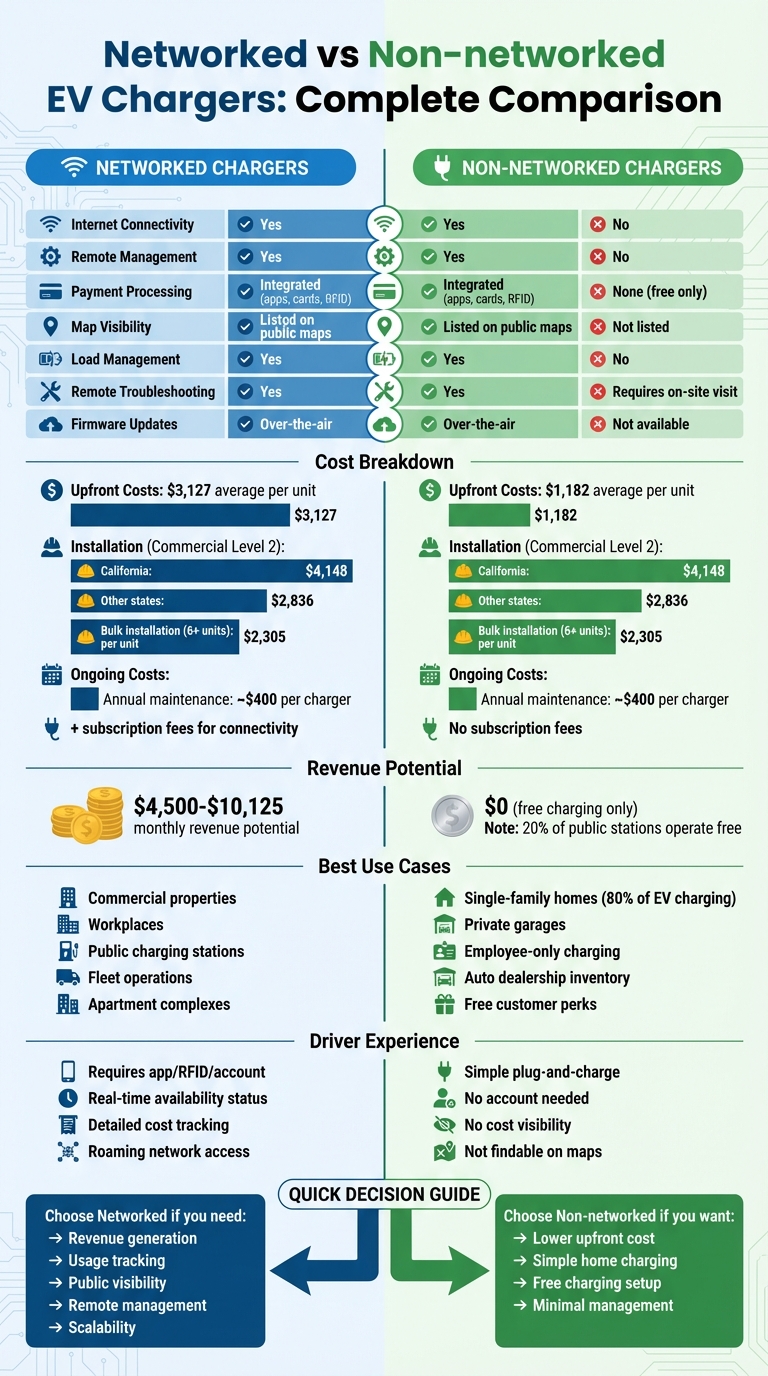
Networked vs Non-networked EV Chargers: Feature and Cost Comparison
Networked chargers connect to the internet or cloud platforms, allowing you to manage your charging stations remotely. This means you can monitor charging sessions, track energy consumption, and even troubleshoot technical issues without needing to be on-site. Real-time diagnostics send instant alerts, helping you address problems quickly and minimize downtime. Plus, over-the-air firmware updates ensure your equipment stays up-to-date.
For properties managing multiple chargers, this remote access is a game-changer. Instant notifications about irregular usage or offline units help maintain smooth operations and reduce disruptions.
Networked chargers go beyond basic functionality by offering advanced tools like load management software. This software intelligently distributes power among multiple chargers, preventing overloads and eliminating the need for expensive electrical upgrades when multiple units share a circuit.
Payment processing is another key feature, supporting options like mobile apps, credit cards, and RFID. Dynamic pricing capabilities let you adjust rates based on demand, while integration with building energy systems allows you to sync chargers with solar panels or battery storage. This not only maximizes renewable energy use but also helps lower your overall operating costs.
Networked chargers are perfect for commercial properties, workplaces, and apartment complexes where tracking usage, managing access, and collecting payments are essential. Public charging stations also benefit significantly, as these chargers can appear on driver apps like Google Maps and PlugShare, making them easier for EV drivers to find.
For example, in November 2023, the City of Palo Alto upgraded its EV charging infrastructure with CyberSwitching CSE1 models to enhance reliability and management capabilities. Similarly, in September 2022, the City of San Ramon, CA, rolled out a new EV charging project using CyberSwitching technology to support both municipal fleet operations and public charging. These examples highlight how networked systems can effectively manage fleet operations and public use through a single, centralized dashboard.
Fleet operators also benefit greatly from networked chargers. They can schedule charging during off-peak hours to save on electricity costs while ensuring vehicles are ready to go when needed. A centralized dashboard simplifies the process of managing chargers across multiple locations, making it easier to expand your charging network as demand grows.
These features make networked chargers an ideal choice for high-traffic areas and environments that require active management, setting them apart from the more basic functionality of non-networked solutions.
Non-networked EV chargers are as straightforward as it gets. These plug-and-play devices deliver power directly from your home’s electrical grid to your vehicle – no Wi-Fi, cellular service, or Ethernet connection required. Once plugged in, they provide a steady flow of power until your vehicle is fully charged, without any external communication involved.
These chargers rely solely on the physical connection between your EV and your home’s electrical panel. To track charging progress, you’ll need to check the LED status lights on the charger itself or refer to your vehicle’s dashboard. Unlike networked chargers, these units don’t come with software interfaces, remote access, or centralized management tools. Most residential non-networked chargers deliver charging speeds between 3.3 kW and 11 kW, which translates to roughly 10 to 40 miles of range per hour for Level 2 chargers.
"Non-networked charging stations are simple and straightforward to use. They do not require any special software or apps and can be accessed by anyone with an EV." – Tennessee Clean Fuels
While these chargers are reliable for basic needs, their simplicity does come with some trade-offs.
The no-frills design of non-networked chargers means they lack many features that networked options offer. For starters, they can’t process payments or track individual user consumption, making them suitable only for free charging scenarios. They also don’t show up on public EV charging maps, which makes them invisible to drivers searching for nearby stations.
Maintenance and repair can also be a headache. Since these chargers don’t support remote troubleshooting or reboots, fixing an issue requires a technician to visit in person – a service call that can run into hundreds or even thousands of dollars. Additionally, they don’t support over-the-air firmware updates, can’t participate in demand response programs, and don’t integrate with other energy systems like solar panels or battery storage.
These limitations highlight where non-networked chargers work well and where they fall short.
Despite their limitations, non-networked chargers shine in settings with minimal management requirements. They’re ideal for single-family homes, where one or two vehicles are charged in a private garage or driveway. Considering that around 80% of EV charging happens at home, these chargers are more than sufficient for most residential needs. With hardware prices ranging from $200 to $1,500, they’re an affordable choice for homeowners who don’t need advanced features.
In commercial environments, non-networked chargers work well for internal operations. For example, auto dealerships can use them to charge inventory, or businesses can deploy them for private EV fleets. They’re also a good fit for locations offering free charging as a perk for employees or customers, where tracking usage or handling payments isn’t necessary.
However, it’s worth noting that upgrading to a networked system later may require replacing the entire unit, which could offset the initial cost savings. While installation costs are comparable to networked chargers, the primary savings come from the lower hardware price.
The price difference between networked and non-networked chargers is striking. Non-networked Level 2 chargers typically cost around $1,182 per unit, while networked versions average a much higher $3,127 per charger. For residential setups, basic Level 2 hardware costs usually fall between $380 and $690.
When it comes to installation, labor and materials for commercial Level 2 chargers range from $2,305 to $4,148 per unit. Costs are notably higher in California, where the average is $4,148, compared to $2,836 in other states. The distance between the charger and the electrical panel plays a big role in determining costs – shorter distances mean less expense for conduit and trenching. However, if the existing electrical service isn’t sufficient, panel upgrades can add another $650 to $2,000 to the total.
Installing multiple chargers at once can help lower costs. For example, installing six or more Level 2 chargers at a single location reduces the average cost to $2,305 per charger outside California, compared to the $2,836 average for single installations. Additionally, permitting fees generally range from $50 to $300. These upfront costs lay the foundation for understanding the longer-term expenses tied to maintenance and operation.
After installation, ongoing costs come into play. Networked chargers incur recurring subscription fees for cellular or internet connectivity and data management portals, costs that non-networked chargers don’t have. Both types require regular maintenance – tasks like cleaning and cable checks are standard. However, networked chargers offer remote troubleshooting and software updates, while non-networked units rely on physical inspections to identify problems.
Owners should plan to spend about $200 to $400 per year, per charger on maintenance. For DC fast chargers, extended warranties can push annual costs above $800. On the bright side, ENERGY STAR-certified chargers consume 40% less energy in standby mode. Over its lifetime, a certified 50 kW DC fast charger could save approximately $1,650 in electricity costs.
Beyond installation and upkeep, revenue generation can significantly impact the overall value of a charger. Networked chargers simplify revenue collection with built-in payment systems, allowing for flexible pricing models like per kilowatt-hour, session duration, or membership plans. Non-networked chargers, on the other hand, lack these automated features and require manual payment methods, such as parking attendants or third-party RFID systems.
Interestingly, about 20% of public charging stations currently operate free of charge, generating no direct revenue to offset operating costs. Networked systems, however, offer detailed usage data that can guide pricing strategies and help track return on investment. Achieving comparable insights with non-networked chargers would require additional tools like separate electric meters or third-party monitoring software.
Non-networked chargers offer a straightforward plug-and-charge experience. No apps, accounts, or extra steps are needed – drivers simply plug in, and charging starts right away. On the other hand, networked chargers require drivers to take an additional step, such as unlocking the station via a mobile app, RFID card, or user account, before charging can begin. While this process adds a minor layer of complexity, it comes with benefits like payment processing and usage tracking. However, it’s worth noting that nearly 21% of drivers in a recent study reported difficulties using public charging stations.
This simplicity versus added functionality creates a distinct user experience, which also impacts how these chargers are visible to drivers.
For drivers, finding a charging station quickly and easily is a key part of the experience. Networked chargers excel in this area – they are listed on public charging maps, complete with real-time updates on availability, usage, and maintenance status. This ensures drivers can plan their trips with confidence. Non-networked chargers, however, are not connected to these platforms, leaving their locations largely unknown unless drivers already know where to find them. With around 12,000 non-networked public EV charging stations in the U.S., many remain hidden from most EV drivers.
"Without connectivity, your station won’t show up on the map. It’s that simple. If you want drivers to be able to find you… then a networked EV charging station is the only choice." – NovaCHARGE
Payment options further highlight the differences between networked and non-networked chargers. Networked systems integrate billing features, allowing drivers to pay through mobile apps, credit cards, RFID cards, or membership accounts. These systems also provide detailed session reports on energy usage and costs, and many support roaming, enabling users to charge across partner networks with a single account. By contrast, non-networked chargers typically offer free charging but lack integrated payment systems or detailed cost tracking. For drivers, it’s a clear trade-off: networked chargers bring flexibility and transparency, while non-networked chargers keep things simple and cost-free.
Here’s a quick comparison of the two systems:
| Feature | Networked Chargers | Non-networked Chargers |
|---|---|---|
| Driver Access | App, RFID, or account required | Plug-and-charge, RFID |
| Map Visibility | Automatically listed on public maps | Generally unlisted |
| Payment | Integrated mobile/credit payments | Typically free |
| Real-time Status | Available via app | Not available |
When deciding between networked and non-networked chargers, the key considerations revolve around control, revenue potential, and visibility on public charging maps. Networked chargers, which require an internet connection, come with higher upfront costs but allow owners to manage pricing, monitor usage remotely, and list their chargers on public maps for EV drivers to find easily. On the other hand, non-networked chargers are more affordable, typically ranging from a few hundred to a few thousand dollars. However, they lack features like remote management, payment processing, and public visibility, making them better suited for free charging setups.
Another major difference is maintenance. Networked chargers often allow remote troubleshooting, such as rebooting, while non-networked chargers require an on-site technician for repairs. For businesses planning to expand their charging infrastructure, networked chargers also offer load management tools like Power Sharing. This feature optimizes the use of existing electrical capacity, enabling more chargers to be installed without requiring costly upgrades to the power supply. These differences highlight the importance of evaluating the specific needs of your site before making a decision.
Your choice will impact not only the upfront installation costs but also the long-term flexibility and potential revenue your charging setup can generate.
Revenue generation is a key factor. If you plan to charge users for electricity or offset operational costs, a networked charger is essential. Non-networked chargers only support free charging and lack the ability to track usage.
Another consideration is visibility and connectivity. For locations like commercial properties, retail spaces, or municipal installations, networked chargers are a better fit because they automatically appear on public charging maps, helping attract EV drivers. In contrast, non-networked units work well in private or low-traffic areas, such as employee parking lots, where charging is offered as a free amenity. Just keep in mind that networked chargers require a reliable internet connection, whether through 4G/5G or WiFi, to function properly.
Lastly, future-proofing your setup is crucial. During the initial installation, consider adding extra conduits to make future expansions easier and less expensive. In some cases, commercial charging stations can generate annual revenues ranging from $3,500 to $10,125, depending on usage patterns. This makes networked chargers a smart investment for businesses looking to offset electricity costs and attract EV drivers over the long term.
The price tag for networked and non-networked EV chargers varies significantly, mainly due to differences in features and ongoing expenses.
Non-networked chargers are the more budget-friendly option, usually costing anywhere from a few hundred to a few thousand dollars. These chargers are simpler in design, lacking advanced connectivity features. They’re a great fit for residential settings where remote management isn’t a priority.
On the flip side, networked chargers come with a heftier upfront cost, often running into several thousand dollars. This higher price is due to their built-in technology, which enables remote management and other advanced features. Additionally, they bring recurring costs, such as subscription fees for connectivity and data services. Despite the extra expense, these chargers offer perks like remote monitoring, scalability, and the ability to collect usage data – benefits that are particularly appealing for businesses or larger installations.
In the end, your decision boils down to what you need. If advanced features and remote capabilities are a must-have, a networked charger could be worth the investment. For simpler needs, a non-networked charger might do the job just fine.
Networked EV chargers bring a host of benefits to managing charging stations, starting with remote monitoring and control via online platforms. With this capability, operators can keep an eye on charger status, track usage patterns, and evaluate performance in real-time. This means faster issue resolution and less downtime.
Another key advantage is data collection and analysis, which helps fine-tune charger placement and improve usage efficiency. Many of these systems also come equipped with features like automated billing, adjustable pricing options, and access control. These tools make networked chargers an excellent choice for commercial and public spaces, all while enhancing the convenience and experience for users.
Many non-networked EV chargers have the potential to be upgraded to networked systems later on, but this largely depends on the charger’s built-in hardware and software. Some models are specifically designed to begin as non-networked and can be transitioned to a networked setup with the right updates or additional components.
If this is something you’re considering, be sure to check with the manufacturer to confirm compatibility and verify that the charger can handle future upgrades. This approach can be a smart choice for those looking to minimize upfront costs while leaving room to expand functionality later.