
Offering EV chargers in apartment buildings is no longer just an option – it’s a smart move to attract and retain tenants while future-proofing your property. With the rise of electric vehicle (EV) ownership, providing reliable charging solutions is increasingly important. Here’s a quick breakdown of what you need to know:
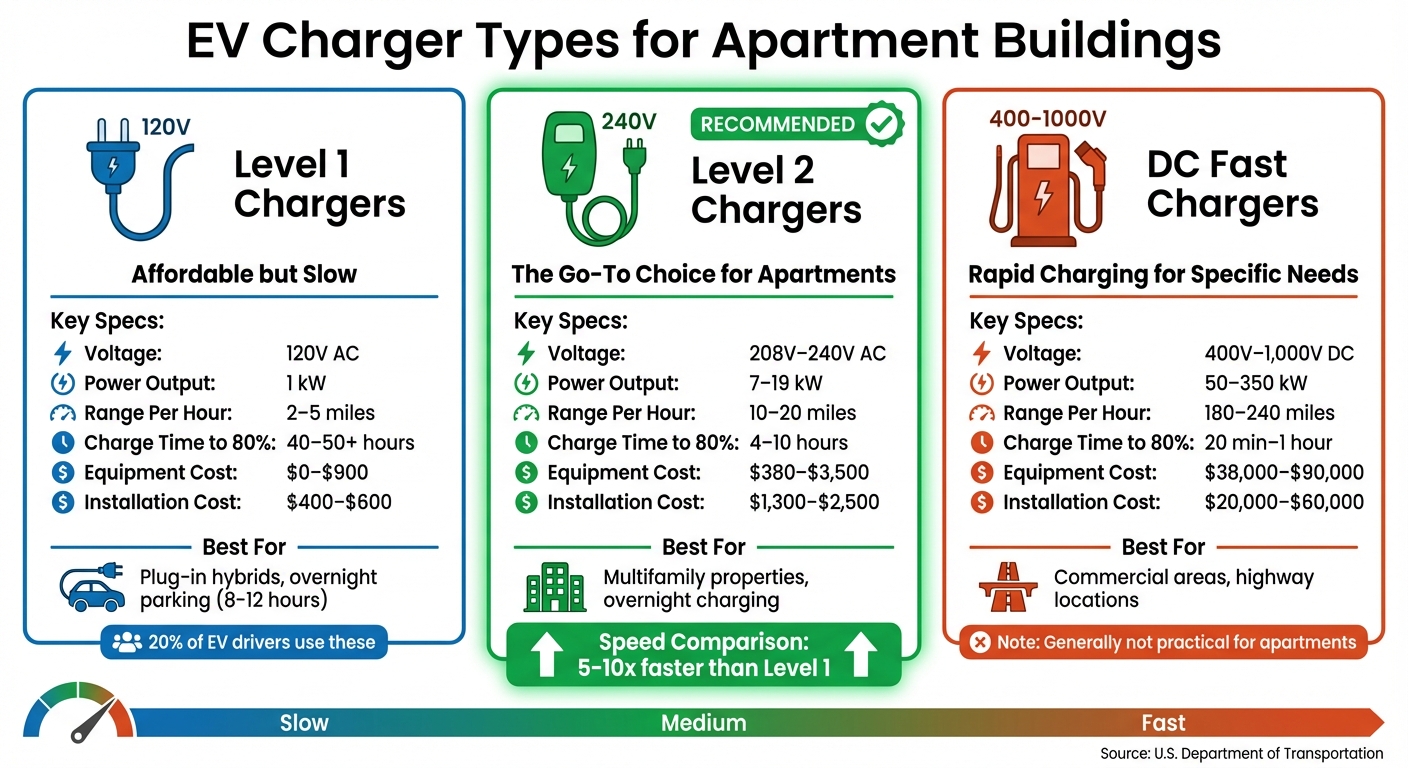
EV Charger Types Comparison: Level 1, Level 2, and DC Fast Chargers for Apartments
Choosing the right EV charger for an apartment complex depends on how long vehicles typically stay parked and the needs of the residents. The three main options – Level 1, Level 2, and DC fast chargers – vary significantly in speed, cost, and power requirements. To make an informed decision, it’s important to understand how these chargers compare. Here’s a breakdown to help guide your planning for efficient and scalable EV charging.
Level 1 chargers plug into standard 120V outlets and provide 2–5 miles of range per hour. Charging up to 80% can take more than 40 hours. Equipment costs range from $0 to $500, while installation typically costs between $400 and $600 per connector.
Although slow, over 20% of EV drivers rely on these basic 120V outlets for their daily charging needs. Level 1 chargers are ideal for plug-in hybrids or EV owners who park overnight for 8 to 12 hours and only need a small recharge.
Level 2 chargers operate on 208V to 240V, delivering 7 kW to 19 kW of power. This translates to 10 to 60 miles of range per hour, with a full charge possible in 3 to 10 hours. Compared to Level 1, these chargers are 5 to 10 times faster for fully electric vehicles.
Nick Kline, Deputy Director of Clean Fuels and Infrastructure at CALSTART, notes: “As of now, Level 2 chargers are the most commonly available at apartment buildings”.
Costs for residential-grade equipment range from $380 to $690, while commercial-grade units average $3,500. Installation costs typically fall between $1,300 and $2,500 per connector. This balance of speed and affordability makes Level 2 chargers the standard choice for multifamily properties.
DC fast chargers are the speed demons of EV charging, providing 50 kW to 350 kW of power through 400V to 1,000V DC current. They can add 180 to 240 miles of range per hour and charge vehicles to 80% in just 20 minutes to 1 hour. However, this speed comes with a hefty price tag: equipment costs range from $38,000 to $90,000, and installation adds another $20,000 to $60,000 per connector.
Due to their high costs and power requirements, DC fast chargers are typically found in commercial areas or along highways where quick turnover is essential. For apartment buildings, where vehicles are parked for long periods, they’re generally not practical.
| Charger Type | Voltage | Power Output | Range Per Hour | Charge Time to 80% | Equipment Cost | Installation Cost |
|---|---|---|---|---|---|---|
| Level 1 | 120V AC | 1 kW | 2–5 miles | 40–50+ hours | $0–$900 | $400–$600 |
| Level 2 | 208V–240V AC | 7–19 kW | 10–60 miles | 3–10 hours | $1,000–$3,500 | $1,300–$2,500 |
| DC Fast | 400V–1,000V DC | 50–350 kW | 180–240 miles | 20 min–1 hour | $38,000–$90,000 | $20,000–$60,000 |
Source: Adapted from U.S. Department of Transportation [4][3]
Once you’ve chosen the right type of EV charger, the next step is ensuring your electrical system can handle the demands of continuous charging. This is especially important for buildings already supporting other heavy electrical loads, like HVAC systems or dryers.
The first step is to have a certified electrician evaluate your building’s electrical system. They’ll inspect existing panels, measure output voltages (e.g., 120/208V, 120/240V, or 480V), and determine the current draw and remaining capacity.
For instance, a 250-amp three-phase panel can typically support up to four 22 kW chargers. Since Level 2 chargers usually require about 32 amps per phase, it’s crucial to confirm there’s enough room in your electrical setup for additional equipment like step-down transformers, subpanels, or disconnects. Early communication with your local utility company is essential to figure out if your existing service can handle the extra demand or if a new service drop is necessary. If the current capacity falls short, adding a separate electrical service specifically for EV charging can be simpler and allows for independent utility metering.
To avoid costly upgrades, load management systems can help optimize your building’s existing electrical capacity. Dynamic Load Management (DLM) is one such solution, as it adjusts power distribution in real-time based on demand, preventing overloads. This technology ensures that power is allocated efficiently among charging vehicles.
“DLM helps businesses maximize existing infrastructure by intelligently managing power distribution, reducing or eliminating the need for expensive panel and transformer upgrades.”
– Nick Zamanov, Industry Expert, CyberSwitching
DLM systems also allow users to schedule charging during off-peak hours, lowering costs and demand charges. By reducing the number of dedicated circuits needed for EV chargers, load management technologies can significantly cut installation costs. This is particularly beneficial for residential setups, where home charging is estimated to cost 35% less than public charging stations. Investing in DLM now ensures your building is ready for the growing demand for EV charging.
Choosing between dedicated circuits and shared circuits is a critical decision that affects both the initial cost and future scalability of your EV charging system. Here’s a comparison:
| Feature | Single Circuit (Dedicated) | Shared Circuit (Load Management) |
|---|---|---|
| Cost | Higher; requires more breakers and wiring | Lower; multiple chargers share one circuit |
| Electrical Impact | Quickly uses up panel capacity | Optimizes existing capacity |
| Complexity | Straightforward; no software needed | Requires load management controllers |
| Scalability | Limited by panel space | Easily expandable for future growth |
| Power Delivery | Full power to one vehicle | Power is distributed based on demand |
Shared circuit setups, combined with smart chargers and devices like the Electric Vehicle Management Controller (EVMC), allow you to maximize the number of chargers without needing major upgrades to your electrical infrastructure. While this approach adds some complexity, it provides a flexible and scalable solution as EV adoption continues to rise. This balance between load management and panel capacity planning ensures your charging infrastructure is ready to grow alongside demand.
The OCPP (Open Charge Point Protocol) allows EV chargers to communicate seamlessly with any energy management platform. This ensures you’re not tied to a single vendor’s ecosystem, giving you the freedom to switch software providers later without needing to replace your chargers. This open system approach helps multifamily properties save money over time and adapt as needed. Additionally, make sure the chargers support universal plug compatibility to accommodate all EV models. Now, let’s look at how smart charging features can simplify managing these systems.
After connectivity is sorted, smart charging features take efficiency and user experience to the next level. With tools like remote monitoring and automated billing, you can easily track uptime, schedule maintenance, and manage pay-per-use systems. Mobile app integration gives residents control over their charging sessions, while RFID card readers ensure only authorized users can access the chargers. Considering that about 80% of EV charging happens at home or work, offering convenient and user-friendly access can make your property more appealing to current and potential residents.
As EV adoption grows, preparing for future demand is critical. Modular charger designs are a smart choice to accommodate the rising number of EVs. For context, there were 1.7 million EVs on U.S. roads in 2022, and that figure is projected to hit 26 million by 2030. Opting for chargers with higher power rates, ranging from 7.4 kW to 22 kW, ensures compatibility with newer EV models featuring larger batteries.
“EV charging [is transforming] from a premium amenity into a critical infrastructure requirement for multifamily properties.”
– 3V Infrastructure
Planning ahead by installing conduit and ensuring sufficient panel capacity can simplify future expansions. Pairing scalable hardware with smart load management allows you to grow your charging network without costly electrical upgrades or risking your building’s power limits.
CyberSwitching provides three EV charger models tailored for multi-unit residential properties, catering to different capacity requirements and budgets. Each model is built with NEMA 3R enclosures, making them suitable for both indoor garages and outdoor parking areas. Here’s a closer look at the options to help you find the right fit for your property.
The CSE1 is a Level 2 charger designed for all complexes (from small to large to high-end Class A properties). It delivers up to 48A (11.5kW) of power and is available in wall-mount and pedestal configurations. This entry-level model integrates with CyberSwitching’s load management solutions, making it easy to scale as EV adoption increases. It also features dynamic load management, allowing multiple chargers to share the existing electrical infrastructure without requiring costly panel upgrades. This makes it an excellent choice for overnight charging scenarios.
The CSE3 shares the same 48A (11.5kW) output as the CSE1 but includes additional features for larger properties. It provides around 42 miles of range per hour of charging and boasts an impressive 96.98% uptime rate. With a built-in display and CTEP certification for billing transparency, the CSE3 is ideal for commercial settings. It also supports various internet connection options – LAN, WiFi, and 4G – offering flexibility for property managers when setting up the network.
For properties with higher charging demands, the CSE4 delivers 80A of power, making it suitable for residents with larger EV batteries or for buildings expecting rapid EV adoption. Available in single-port ($2,050) and dual-port ($3,550) configurations, the dual-port option can serve two parking spaces from one pedestal, reducing installation costs. This model is perfect for future-proofing properties that anticipate a surge in EV usage.
| Model | Max Amperage | Power Output | Dual Port Option | Price Range | Best For |
|---|---|---|---|---|---|
| CSE1 | 48A | 11.5kW | Yes | $1,190–$1,320 | Small to Large complexes, budget-friendly properties |
| CSE3 | 48A | 11.5kW | Yes | $1,250–$1,390 | Small to Large complexes, when a screen is needed |
| CSE4 | 80A | 19.2kW | Yes | $2,050–$3,550 | High-demand properties, EV growth planning |
Setting up Level 2 EV chargers can be a significant investment, with installation costs typically exceeding $2,000 per unit. For a project involving six chargers, the total can climb to $12,000 or more. These estimates include hardware, labor, electrical upgrades, and permitting fees.
Labor tends to be the biggest expense, but installing multiple chargers at once can help reduce the cost per unit. One way to cut costs is by choosing locations close to existing electrical panels, which minimizes the need for extensive trenching and wiring. Additionally, reach out to your local utility company to ask about available TTM programs and rebates – some utilities even cover infrastructure upgrades up to the building’s meter.
“The cost to install a condo charging station often surpasses the initial expectations of apartment owners in condo buildings. The installation may require a larger budget if the electrical connection of the building or the service panel has to be upgraded.” – Cyberswitching
Beyond installation, don’t forget to account for ongoing costs such as network management fees, electricity, and regular maintenance. To ensure your building’s electrical panel can handle the additional load, have a certified electrician perform an assessment.
Once you’ve calculated the installation costs, explore available incentives to help offset the initial investment.
The 30C Alternative Fuel Infrastructure Tax Credit can cover up to 30% of your total installation costs. Even better, this federal credit can often be combined with state-level grants and utility rebates, significantly reducing your upfront expenses. To see if your property qualifies, use the 30C Tax Credit Eligibility Locator tool from Argonne National Laboratory.
“Federal tax credits can cover up to 30% of the cost of charging equipment and installation. This can often be paired with utility incentives such as rebates, free chargers, or reduced charging rates.” – Plug In America
States also offer their own programs to assist with costs. For example, California’s CALeVIP provides a 50% cost-share for underserved communities. Similarly, New York’s Charge NY offers rebates for multifamily buildings. On the federal level, the NEVI Formula Program is a $5 billion initiative that resumes in January 2026, while the Energy Improvement in Rural or Remote Areas (ERA) program allocates $1 billion to support rural communities. Utility providers like Southern California Edison and PG&E also offer rebates and alternative ownership models to help with installation costs.
By leveraging these incentives, you can significantly lower your upfront costs while preparing for the growing demand for EV infrastructure.
When planning your EV charging setup, think ahead. Installing conduit and wiring throughout the parking area now can save you from expensive labor and construction costs down the line.
Smart load management is another key consideration. This technology allows multiple chargers to share a single circuit or panel capacity, enabling you to add more units later without requiring costly electrical upgrades. Additionally, opt for hardware that supports Open Charge Point Protocol (OCPP) version 1.6 or higher. This ensures flexibility, allowing you to switch network providers without needing to replace the charging stations themselves.
Idle fees can also be a practical solution. By implementing these through your management software, you can encourage users to move their vehicles once charging is complete, freeing up space for others. For underground garages or areas with poor cellular signals, Bluetooth-enabled chargers can provide more reliable connectivity.
Lastly, take the time to survey resident demand. Understanding how and when chargers will be used can help you select the right type of equipment for your community.
Choosing the right EV charger for your apartment building comes down to three key factors: understanding what your tenants need, evaluating your building’s electrical capacity, and planning ahead for future growth. With EV ownership in the U.S. projected to hit 26 million vehicles by 2030, there’s no better time to get started.
Level 2 chargers are the go-to choice, offering 10–60 miles of range per hour – perfect for overnight charging. Combine these with intelligent load management, and you can maximize your existing electrical setup while avoiding expensive infrastructure upgrades. This approach not only addresses current needs but also positions your property to handle the growing demand for EV charging. Considering that 80% of EV charging happens at home or work, having on-site charging is quickly becoming essential.
CyberSwitching provides EV charging solutions designed specifically for apartment buildings. Whether you need the Cyber EV Charger CSE1 for standard installations or the Dual 80A Commercial EV Charger CSE4 for higher demand, their products deliver. With features like OCPP and RFID access control, along with built-in load management and scalability options, these chargers ensure your property is ready for the future while offering secure and efficient charging today.
Level 2 EV chargers bring a lot to the table for apartment buildings. First off, they deliver faster charging speeds, adding roughly 20–30 miles of range per hour. This makes them perfect for residents who need a reliable and convenient way to charge their vehicles – whether overnight or during shorter windows of time. For tenants juggling busy schedules or daily commutes, this faster charging is a game-changer.
But it’s not just about convenience. Installing Level 2 chargers can make your property more appealing and even boost its value. As more people switch to electric vehicles, offering on-site charging becomes a sought-after amenity. It can help you attract new tenants, keep current ones happy, and may even justify higher rent prices. Plus, there’s potential to generate extra income by setting charging fees or managing electricity usage effectively.
What’s more, these chargers are scalable. That means they can grow with the increasing number of EVs on the road, making them a smart, forward-thinking investment for multifamily properties.
Dynamic Load Management (DLM) is a smart way to cut down on installation costs by making the most of the existing electrical setup in apartment buildings. Instead of needing a separate circuit for every EV charger, DLM uses real-time demand to distribute power across multiple chargers. This approach reduces the need for costly upgrades, like reinforcing electrical panels or adding new circuits.
With DLM, property owners can fit more chargers into the current electrical capacity, which means lower upfront costs and fewer long-term infrastructure expenses. Tenants also benefit from reliable charging access without the risk of overloading the system. Plus, as more residents adopt EVs, scaling up becomes much simpler. DLM offers a practical, budget-friendly way to prepare multi-unit buildings for the growing demand for EV charging.
Installing EV chargers in multifamily properties can be more affordable than you think, thanks to a variety of financial incentives. Programs like California’s Communities in Charge initiative, for instance, allocate millions of dollars to support the installation of Level 1 and Level 2 chargers at apartment complexes.
On top of that, federal and state tax credits – such as the Alternative Fuel Vehicle Refueling Property Credit – can help cut down installation costs. Many states also provide rebates and additional funding specifically aimed at boosting EV infrastructure in residential properties. To make the most of these opportunities, be sure to research both federal and local programs that align with your needs.