
Choosing the right EV charging solution is complex but critical for long-term success. Here’s a quick breakdown of the key considerations:
Quick Tip: A modular, open-protocol charger ensures flexibility for future upgrades and compatibility with evolving EV standards.
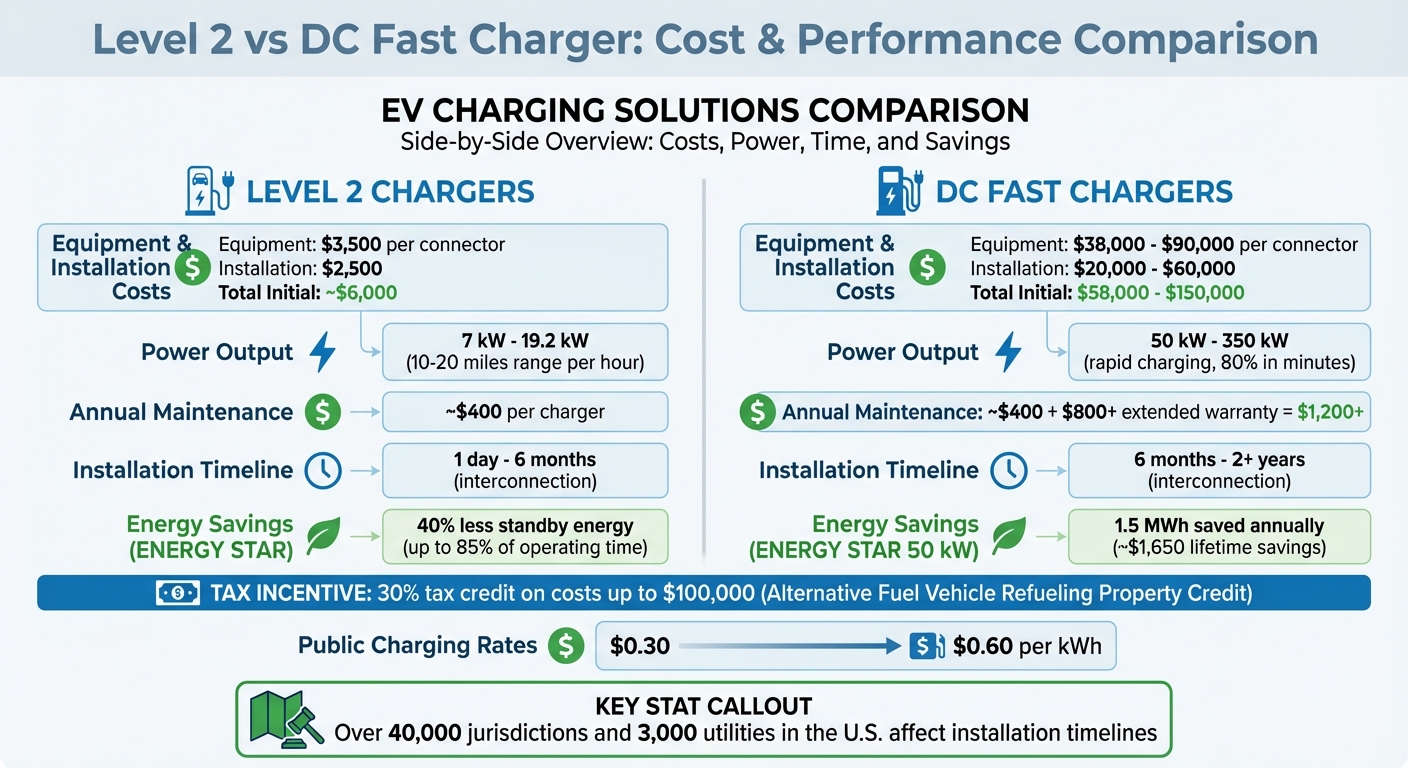
EV Charger Comparison: Level 2 vs DC Fast Charging Costs and Specifications
When setting up EV chargers, it’s crucial to align the charging power with how long the vehicle will be parked. For example, Level 2 charging (208–240V) works well for vehicles parked overnight or during an eight-hour shift. On the other hand, DC fast charging is better suited for delivery fleets that need quick turnarounds.
Level 2 chargers typically provide between 7 kW and 19.2 kW, which translates to about 10–20 miles of range per hour. A common commercial setup is a 48-amp, 11.5 kW charger, which strikes a balance between charging speed and electrical requirements. Most modern EVs are designed to accept AC current in the 40–50 amp range.
However, keep in mind that the EV’s onboard charger determines the actual charging speed, regardless of the station’s output. As EVgo explains:
“The maximum rate of your charging session is determined by whichever is lower, the capability of the car or the charger”.
For instance, a vehicle with a 50 kW acceptance rate won’t charge faster even if connected to a 350 kW station.
When using DC fast chargers, be aware of the 80% rule. Charging slows significantly after reaching 80% capacity to protect the battery, and that last 20% can take as long as the initial 80%. This charging curve is an important factor to consider when planning fleet operations.
Before investing in chargers, check the vehicle manual for details on its maximum AC amperage and DC acceptance rate. Also, ensure your electrical panel can handle the load. According to the National Electrical Code, circuit breakers must be sized at 125% of the charger’s amperage. For example, a 48A charger requires a 60A breaker to prevent overheating and ensure safe, continuous use.
Lastly, confirm that your chosen charging solution is compatible with all the EV models in your fleet. Compatibility is key to ensuring smooth operations.
Once you’ve aligned power capabilities with usage, the next step is to confirm that your chargers are compatible with the EV models you plan to serve. In North America, it’s essential to select chargers that support SAE J1772 for AC charging and both CCS1 and NACS (SAE J3400) for DC fast charging. This avoids unnecessary limitations and ensures broader usability. Notably, major automakers like Ford, General Motors, Rivian, Volvo, BMW, and Hyundai are transitioning to NACS ports, with many planning native integration by 2025. This compatibility also lays the groundwork for integrating advanced management systems.
Another critical factor is ensuring that chargers can communicate effectively with management systems. Adopting chargers that support the Open Charge Point Protocol (OCPP) – specifically version 2.0.1 – helps avoid vendor lock-in. OCPP 2.0.1 also enables advanced features like remote firmware updates, real-time diagnostics, and data collection.
“When products are certified to OCPP, this protects investments in EV charging infrastructure by reducing vendor lock-in risks.”
– Carolyn Weiner and Levin Nock, EVCAN
For a seamless user experience, look for chargers with support for ISO 15118, which enables “Plug & Charge” functionality. This automates processes like authentication and billing, making charging more convenient for users. Additionally, for installations that need to accommodate evolving EV standards, modular chargers with replaceable connector heads are a smart choice. These allow you to adapt to new physical standards without needing to replace the entire charging unit.
Before making a purchase, confirm that the chargers comply with OCPP 2.0.1 and support all necessary connector types. By focusing on flexibility and open protocols, you’ll address current demands while ensuring adaptability for future needs.
Once you’ve ensured compatibility, it’s time to think long-term. Your EV charging infrastructure should be designed to grow with demand, ideally looking ahead at least a decade. With electric vehicles projected to make up over two-thirds of global new car sales by 2030, planning for increased capacity now can save you from expensive upgrades later on. A smart move during the initial build is to “stub out” – installing extra conduit, larger transformers, and boosting electrical capacity upfront. This minimizes the cost and disruption of adding more chargers in the future.
Efficient scaling also hinges on smart load management. Instead of designing your electrical system to handle every charger running at full power simultaneously, use software to manage power distribution dynamically. Adaptive Load Management systems allocate energy based on factors like departure times and charging needs, letting you add more chargers without overhauling your electrical service. This method could cut infrastructure costs by as much as 60% compared to traditional approaches.
“Undershooting on charging infrastructure will only lead to greater expenses down the road, so planning and design must be detailed enough to minimize long-term costs and maximize benefits.”
– PowerFlex
Keep in mind that temperature affects EV battery performance. At 32°F, batteries accept 36% less energy compared to 77°F, meaning colder climates may need more charging stations or allow for longer charging times. For locations like workplaces or apartment complexes where vehicles are parked for extended periods, prioritize Level 2 chargers. These are more cost-effective to expand than DC fast chargers and work well in these scenarios. Multi-port chargers, which can serve multiple parking spots at once, are another way to make the most of your space and electrical setup.
To avoid being locked into a single vendor as your needs evolve, choose a Charge Management System that supports OCPP (Open Charge Point Protocol). It’s also a good idea to collaborate with your utility provider early. They can help identify potential grid constraints and may offer support to address them. By incorporating scalability into your initial design, you’ll avoid the headaches and costs of frequent retrofits, setting yourself up for smooth growth as demand increases. This approach also lays the groundwork for exploring cost-saving and advanced power management strategies.
Once you’ve planned for future capacity, it’s time to weigh the financial side of things. Evaluating the total cost of ownership (TCO) is essential. This includes not just the equipment itself but also trenching, contractor fees, electrical upgrades, and ongoing maintenance costs.
Let’s break down the upfront costs. For Level 2 chargers, the equipment typically costs around $3,500 per connector, with installation adding another $2,500. On the other hand, DC fast chargers are a much bigger investment, ranging from $38,000 to $90,000 per connector, plus $20,000 to $60,000 for installation. Then there are the soft costs – things like permitting, siting, and utility interconnection. These can often exceed the hardware costs, and they vary widely depending on your location. For example, there are over 40,000 authorities having jurisdiction and 3,000 utilities across the U.S., which means interconnection timelines can range from 1 day to 6 months for Level 2 chargers or stretch from 6 months to over 2 years for DC fast chargers.
Once installed, annual maintenance is another expense to consider. Expect to pay about $400 per charger, with extended warranties for DC fast chargers adding over $1,000 per year. Energy costs are another factor, including per-kilowatt-hour fees and demand charges based on peak usage. However, using smart load management software to shift charging to off-peak hours can help cut these costs. ENERGY STAR-certified chargers are another way to save. For instance, Level 1 and Level 2 chargers certified by ENERGY STAR use 40% less energy in standby mode – important since standby can account for up to 85% of their operating time. A certified 50 kW DC fast charger can save about 1.5 MWh annually, translating to roughly $1,650 in lifetime savings.
There are also incentives to ease the financial burden. The Alternative Fuel Vehicle Refueling Property Credit offers a 30% tax credit on costs up to $100,000 in qualifying locations. Additionally, grouping chargers in one area can lower construction costs by consolidating trenching for power and data. To offset operational costs, consider fee structures like charging per kilowatt-hour, session duration, or offering subscription plans. Public charging rates usually fall between $0.30 and $0.60 per kWh. Interestingly, about 70% of EV owners earn $75,000 or more annually, and a similar percentage hold a college degree. This makes free charging an appealing perk to attract high-income customers.
“Soft costs often can account for a larger portion of the total installation price than direct costs.” – Department of Energy
These financial aspects are just as critical as the technical and operational considerations discussed earlier. They all play a role in ensuring your charging infrastructure is both practical and sustainable over the long term.
Adding power management and remote monitoring to your EV charging setup can dramatically cut costs and streamline operations. These tools allow you to manage charging more efficiently and address issues without being physically present.
Power management software is a game-changer. It lets you install more chargers than your electrical capacity would typically allow. By oversubscribing circuits, you can connect multiple chargers – up to four on a single circuit designed for one – thanks to intelligent power distribution. For context, recommended ratios are 8:1 for long-term parking, 4:1 for overnight fleets, and 2:1 for workplaces with all-day charging. This approach can slash infrastructure costs by as much as 60% [33,46]. Additionally, power management systems can set a “power ceiling”, ensuring your site stays below utility thresholds that could trigger costly peak demand charges [46,47].
Adaptive charging takes efficiency even further by prioritizing vehicles based on departure times and energy needs provided by drivers [33,47]. Research has shown that such systems can increase average charging times from 2 to 2.5 hours – still comfortably within the typical 5-hour parking window. Pairing these techniques with remote monitoring takes operational efficiency to the next level.
Remote monitoring offers real-time insights into station status, energy use, and power consumption. This allows for quick troubleshooting without needing an on-site technician [21,46]. For fleet operators, integrating telematics can help synchronize charging schedules with vehicle routes and even monitor battery health remotely. When choosing a solution, make sure it complies with National Electrical Code Provision 625.41 for automatic load management and supports the Open Charge Point Protocol (OCPP). This ensures flexibility to switch software platforms without replacing hardware.
“The choice of Cyber Switching’s EVMC maps into the County’s sustainability plan across a number of sectors including energy efficiency, transportation, and government operations.” – Jody London, Sustainability Coordinator, Contra Costa County
Here’s a snapshot of CyberSwitching’s Level 2 commercial chargers, designed to meet a range of technical and operational needs.
CyberSwitching offers three models, starting with the CSE1, priced at $1,190. This entry-level charger delivers 48A (11.5 kW) with a solid uptime rate of 96.98%. It’s a great fit for workplaces, apartments, and businesses looking for dependable overnight charging at an affordable price.
The CSE3 steps up with a price range of $1,250 to $1,390. It includes a built-in LCD display and CTEP certification, which is required for commercial billing in California. This model is perfect for retail environments or spaces needing on-screen billing compliance.
For high-demand locations, the CSE4 starts at $1,590 for a single unit. It offers 80A (19.2 kW), nearly doubling the speed of standard 48A chargers. This makes it ideal for fleet operations and parking facilities with a high turnover rate. All three models support OCPP 1.6J, offer RFID authentication, and integrate seamlessly with the OCPP mobile app for payment processing and remote monitoring.
| Model | Price | Max Power | Display | CTEP Certified | Best For |
|---|---|---|---|---|---|
| CSE1 | $1,190 | 48A (11.5 kW) | No (App-based) | No | Workplaces, apartments, small businesses |
| CSE3 | $1,250 | 48A (11.5 kW) | Yes (Built-in LCD) | Yes | Retail locations, California billing compliance |
| CSE4 | $1,590 | 80A (19.2 kW) | LED Indicators / App | No | Commercial fleets, high-turnover parking |
The CSE1 stands out with its 5.0/5 customer rating, praised for its easy installation and ability to fully charge vehicles like the BMW iX in about 8 hours. It’s already trusted by organizations such as UC Davis, HP, Adobe, and the City of Seattle. This comparison highlights essential factors like power, compliance, and efficiency, helping you choose the right charger for your needs.
When choosing an EV charging solution, it’s important to consider factors like charging speed, compatibility, scalability, cost, and power management. High uptime rates and certifications such as ETL and Energy Star can ensure reliable and efficient operation. Planning for future growth with tools like dynamic load management and smart monitoring helps expand your network without expensive electrical upgrades, while strategies like peak-shaving and load balancing optimize energy use and scheduling. Opting for OCPP-compliant hardware ensures compatibility with the latest EV models and evolving charging protocols. Additionally, factoring in installation, maintenance, and demand charges can help maximize your overall return on investment.
CyberSwitching’s product line reflects these principles. Their CSE1, CSE3, and CSE4 chargers offer scalable solutions ranging from 48A (11.5 kW) to 80A (19.2 kW). Features like RFID authentication, OCPP 1.6J support, and mobile payment integration enhance usability. Advanced load balancing capabilities also allow multiple charging stations to share a single circuit breaker, cutting down on infrastructure costs significantly.
With more than 5,000 commercial chargers installed across 47 U.S. states, CyberSwitching provides reliable, forward-thinking charging infrastructure. These five strategies equip you to make informed decisions that meet both your current requirements and future growth, whether you’re managing workplace charging, retail spaces, or large commercial fleets.
When picking an EV charging solution, there are a few things to keep in mind to ensure it fits your requirements. Compatibility should be at the top of your list – confirm that the charger is suitable for your vehicle and works with your current electrical system. Next, assess the charging speed and power capacity. This will depend on whether you need it for personal use or a commercial setup.
You’ll also want to decide between AC or DC chargers, based on how quickly you need your vehicle charged. Don’t forget to consider the installation environment – is it for indoor or outdoor use? If it’s outdoors, you’ll likely need a weatherproof option. Lastly, think long-term. Choose a solution that’s scalable, so it can adapt if you add more EVs or expand your charging infrastructure in the future.
To prepare your EV charging setup for future growth, begin by assessing both your current and expected charging needs. Think about how many vehicles you’ll need to support and the charging speeds they’ll require. It’s also wise to plan for potential electrical capacity upgrades to ensure your system can handle increased demand down the road.
Using smart load management systems is another key step. These systems help optimize energy distribution and make it easier to expand your setup without requiring extensive infrastructure changes. By building this flexibility into your plan, you’ll save both time and money as EV adoption continues to rise.
When planning your budget for an EV charger, it’s important to account for both installation and maintenance expenses. Installation costs for a home charger typically fall between $800 and $3,000, influenced by factors like the distance from your electrical panel and whether your home requires an electrical panel upgrade. If an upgrade is needed, expect the costs to rise.
For ongoing expenses, consider electricity usage, which varies based on your utility rates, how often you charge, and the charger type. Maintenance might include regular servicing, software updates, and possible network fees if your charger is part of a managed system. Don’t forget about additional costs like permits or utility connections. By planning carefully, you can better handle both the upfront and long-term costs.