
EV charging stations do more than just power vehicles – they boost business revenue, increase property values, and reduce operational costs. They also generate direct income and qualify for government incentives. Here’s what you need to know:
These stations aren’t just infrastructure – they’re a smart financial move for businesses and property owners.
5 Economic Benefits of EV Charging Stations: Revenue, Property Value & Cost Savings
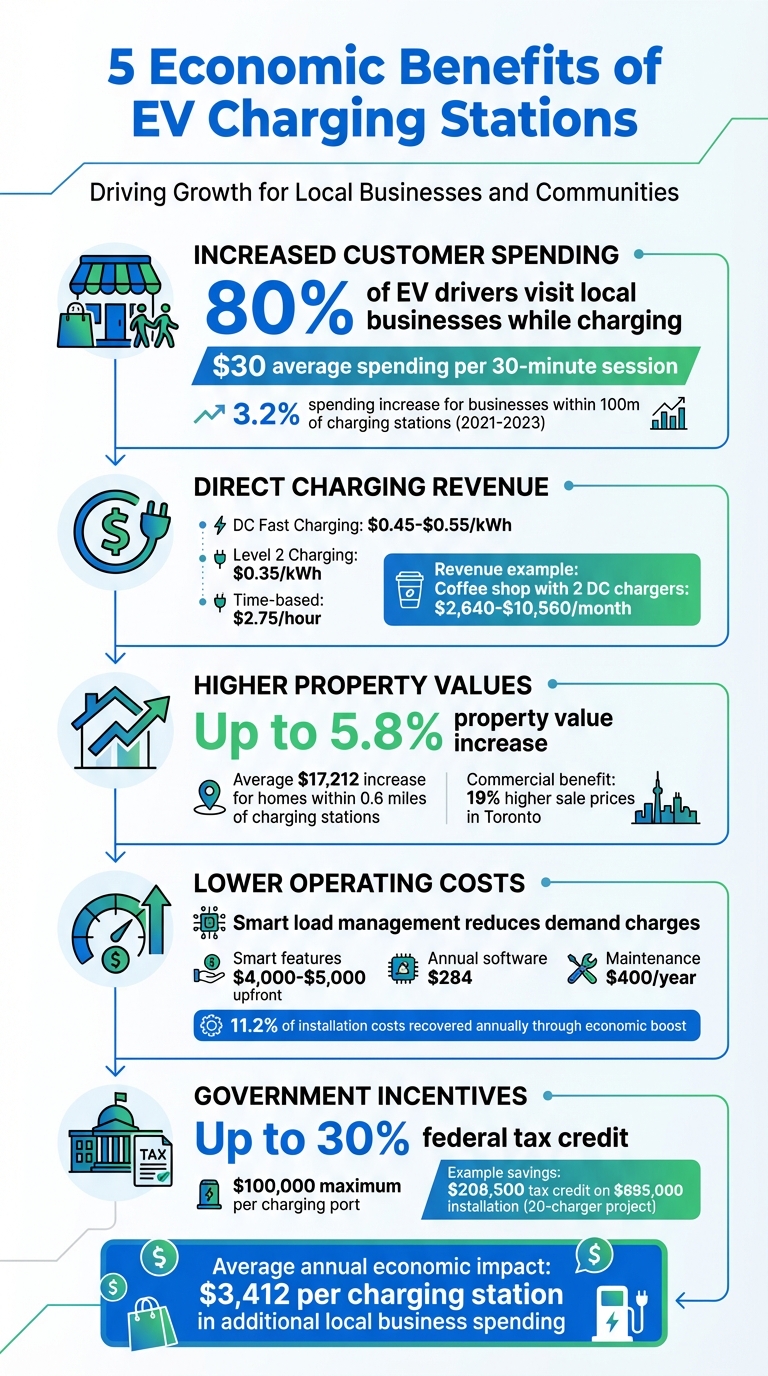
Installing EV charging stations can significantly boost foot traffic for nearby businesses. Since EV drivers typically spend over 30 minutes charging their vehicles, this downtime often translates into opportunities for shopping, dining, or exploring local stores. According to an EVgo survey, 80% of EV drivers visit local businesses while charging, spending an average of $30 during a standard 30-minute session.
Data also shows that businesses located within 100 meters of an EV charging station saw spending increases of up to 3.2% between 2021 and 2023. Even as far back as 2019, adding a single charging port was linked to a 0.21% rise in customer visits and a 0.25% boost in spending.
These localized spending patterns contribute to broader economic benefits for entire business districts, creating a ripple effect of increased revenue.
From January 2021 to June 2023, newly installed EV chargers in California generated $19.5 million in customer spending.
Charging stations, especially Level 2 and moderate-speed DC fast chargers, typically keep users on-site for 30–60 minutes. This extended dwell time not only drives additional revenue for nearby businesses but also opens the door for collaborative cost-sharing opportunities among neighboring establishments.
EV charging stations aren’t just about convenience – they’re also a solid way to generate income directly. Businesses can charge users in a variety of ways, such as per kilowatt-hour (kWh), a flat fee per session, or even based on the time vehicles occupy the charging space. For example, DC fast charging typically costs between $0.45/kWh and $0.55/kWh, while Level 2 charging averages around $0.35/kWh. Time-based fees hover at about $2.75/hour. To put that into perspective, a coffee shop with two DC chargers handling four sessions daily could see $2,640 in gross monthly revenue. In busier locations with eight sessions per day, that number could jump to $10,560 per month.
Smart pricing strategies can make a big difference here. Businesses can use Time of Use (TOU) tariffs through power management software to charge higher rates during peak demand times. This not only helps manage electricity costs but also ensures profit margins stay healthy during busy periods.
Charging stations bring in more than just direct revenue – they open doors to additional income streams. Many modern stations generate money through digital advertising or by promoting the host business’s services. Essentially, every charging station doubles as a mini billboard.
Another approach is revenue-sharing partnerships. In these setups, charging networks handle the installation and maintenance of equipment at no upfront cost to the business. In return, the charging network takes a percentage of the income generated. It’s a win-win that mirrors the classic gas station and convenience store model, where the primary service drives customers to spend on other high-margin products.
“The joint gas station and convenience store business model could also be adopted to EV charging stations.” – Yunhan Zheng, Postdoc, Singapore-MIT Alliance for Research and Technology (SMART)
Federal incentives sweeten the deal even further. Businesses can take advantage of tax credits that cover up to 30% of installation costs or programs that offer as much as $100,000 per charger. These financial perks speed up the path to profitability. Combined, these revenue streams not only increase overall business earnings but also amplify the economic benefits that come from attracting more customers.
Installing EV charging stations has a clear impact on property values. A study analyzing 14 million California housing transactions from 1993 to 2021 revealed that homes within 0.6 miles (1 km) of EV charging stations experienced an average price increase of 3.3%, equivalent to around $17,212. For homes even closer – within 0.4 to 0.5 km – the price premium jumped to 5.8%. These increases benefit both residential homeowners and commercial property owners.
Commercial real estate sees similar advantages. In 2021, the U.S. commercial real estate market was valued at nearly $21 trillion, and properties with EV chargers are standing out in this competitive space. Shopping malls, office buildings, multifamily housing, and medical centers with charging infrastructure are commanding higher valuations. For instance, a real estate study by Properly found that homes with EV chargers sold for 19% more in Toronto and 4.5% more in Vancouver year-over-year. On the commercial side, 80% of workplaces surveyed by the U.S. Department of Energy reported that having on-site chargers helped them attract and retain top talent. This added feature not only boosts property value but also gives landlords an edge in securing high-quality tenants and justifying premium lease rates. These benefits ripple out, supporting local economies and enhancing overall business performance.
EV charging stations also prepare properties for the future. Many municipalities are rolling out new building codes and renovation mandates requiring EV charging infrastructure. Installing stations now helps property owners avoid expensive retrofits later and aligns their buildings with green certifications like LEED. These certifications often lead to higher rental rates, tax incentives, and an improved reputation for sustainability.
Moreover, the financial prospects for EV charging are growing rapidly. Revenue from charging infrastructure is expected to reach $816.4 million by 2028, making it a must-have for modern commercial properties. Much like Wi-Fi transitioned from being a luxury to an essential feature, EV chargers are quickly becoming a baseline expectation. By investing in this infrastructure today, property owners not only future-proof their assets but also position themselves to reap long-term financial rewards.
Smart load management systems aren’t just about keeping EV chargers running – they’re about keeping costs under control. By managing electricity flow strategically, these systems help businesses sidestep hefty demand charges. These charges are utility fees tied to the highest 15-minute power usage during a billing cycle, which can be a major expense, especially for DC fast chargers.
Here’s how load management works: power sharing spreads electricity across multiple charging ports, time-of-use optimization shifts charging to off-peak hours when electricity rates are lower, and peak management limits total power output to avoid costly spikes in demand.
“Electric utility demand charges can have significant impacts on the business model of EV charging stations. High operating costs can make it difficult for charging station site hosts to recover costs or operate profitably.” – Transportation Energy Institute
The upfront investment for smart charging features is around $4,000–$5,000, with additional yearly software fees of $284 and $400 for routine maintenance. While these costs may seem steep, the efficiency gains they deliver more than make up for it, offering businesses a way to cut expenses and gain operational flexibility.
Load management doesn’t just save money – it creates opportunities. By optimizing existing electrical capacity, businesses can add more charging ports without having to pay for costly infrastructure upgrades. This added capacity translates into greater convenience for EV drivers and increased foot traffic for nearby businesses. In fact, the annual economic boost from a charging station can cover about 11.2% of its average installation costs.
Another financial perk? Networked chargers with load management features meet the requirements for programs like the National Electric Vehicle Infrastructure (NEVI) Formula Program. This initiative has allocated $7.5 billion to expand charging infrastructure across the U.S., with Texas receiving roughly $408 million and California about $384 million .
When you combine these operational efficiencies with the revenue potential and property value gains discussed earlier, the case for investing in EV charging infrastructure becomes even stronger.
Federal tax credits can significantly lower the upfront costs of installing EV charging stations. One key program, the Alternative Fuel Vehicle Refueling Property Credit (Section 30C), provides businesses with a tax credit for qualifying charging equipment installed through December 31, 2032. The base credit is 6% of total costs, but if businesses meet Prevailing Wage and Apprenticeship (PWA) requirements, they can claim a full 30% credit, capped at $100,000 per charging port.
To qualify, properties must be located in low-income or non-urban census tracts. You can check your site’s eligibility using the 30C Tax Credit Eligibility Locator tool from Argonne National Laboratory. The credit applies not only to the chargers themselves but also to supporting infrastructure like pedestals, panels, conduit, and wiring.
“The credit for a single item of qualified refueling or recharging property is 6% of the cost including labor… or 30% of the cost including labor if prevailing wage and apprenticeship (PWA) requirements are met.” – IRS
These tax credits can dramatically cut installation costs, making EV charging infrastructure more accessible and affordable. The PWA requirements, in particular, can lead to substantial financial benefits. For instance, in February 2026, the IRS shared an example of a 20-charger (40-port) installation costing $695,000. With PWA compliance, the tax credit amounted to $208,500. Without compliance, the credit dropped to just $41,700 – a staggering difference of $166,800. This level of cost reduction can significantly boost the profitability of installing EV charging stations.
Tax-exempt entities, including local governments, tribes, and nonprofits, can also take advantage of these incentives. They can claim the full credit value as a direct payment from the IRS through elective (direct) pay options. Additionally, local utilities and governments often provide grants and rebates. Engaging with utility companies early in the planning process can help identify these incentives and assess potential grid upgrade costs.
EV charging stations offer financial benefits across various fronts. Local businesses see increased spending from EV drivers, while charging services generate revenue through per-kilowatt-hour fees, time-based pricing, or subscription plans. Additionally, EV infrastructure can enhance property values and lower operating expenses through smart load management systems. Government incentives and grants further help offset the upfront costs of installation.
Studies reveal that a single charging station brought in an average of $3,412 annually in additional spending at nearby businesses between 2021 and 2023, with these economic gains often covering a large portion of installation expenses. Fast-charging station usage rates also saw a rise, doubling from 9% to 18% during 2023, making the financial case for EV infrastructure even stronger.
To help businesses maximize these benefits, CyberSwitching provides commercial EV chargers designed for reliability, efficient load management, and secure payment options. Their Dual 80A CSE4 and 48A/11.5 kW CSE1 models include RFID capabilities and integrate with the mobile apps for real-time monitoring and payment processing.
With more than 5,000 commercial chargers installed across the United States, CyberSwitching’s products meet stringent industry standards, including compatibility with OCPP 1.6 and 2.0.1. They also qualify for major government incentive programs. CyberSwitching’s end-to-end process – expert consultation, certified installation, and ongoing support – helps businesses harness the economic potential of EV charging infrastructure.
EV charging stations can be a great way to increase revenue by drawing EV drivers to your business. Here’s why: 80% of EV drivers tend to shop or dine nearby while their vehicles charge. On average, they spend $30 during a typical 30-minute charging session.
Even better, each charging station has the potential to generate around $1,500 annually in spending at nearby businesses. By providing this amenity, you’re not just attracting more customers – you’re also positioning your business ahead of competitors in the rapidly expanding EV market.
The U.S. federal government has introduced several initiatives to encourage the installation of EV charging stations. One standout program is the Alternative Fuel Vehicle Refueling Property Credit, which offers a tax credit ranging from 6% to 30% of installation costs, capped at $100,000 per qualifying property installed during the tax year. On top of this, more than $7 billion has been allocated under the Infrastructure Investment and Jobs Act to expand EV charging infrastructure across the country.
States also contribute with their own programs, including grants, rebates, and extra tax credits. These combined incentives can significantly lower the costs, making the decision to install EV charging stations a smart financial move for businesses and property owners.
Adding EV charging stations can noticeably increase property values. Research indicates that residential properties within a half-mile of EV chargers may experience price increases of up to 5.8%. For commercial properties, the benefits are just as compelling. The presence of charging stations not only draws in more customers but also makes the property more attractive to tenants and investors who prioritize environmentally-friendly features.
For businesses, installing EV chargers sends a strong message: it shows a commitment to innovation and sustainability. This forward-looking approach can make a property more appealing in a market that’s increasingly focused on green infrastructure. In short, EV charging stations aren’t just a convenience – they’re a strategic move to enhance property value and remain competitive.