If you’re deciding between Level 2 and Level 3 EV chargers, here’s the quick takeaway: Level 2 chargers are ideal for home use, workplaces, and locations where cars stay parked for hours. Level 3 chargers are better for highway stops or businesses needing fast charging.
| Feature | Level 2 | Level 3 (DC Fast Charger) |
|---|---|---|
| Voltage | 208-240V AC | 400-1,000V DC |
| Power Output | 7-19.2 kW | 50-350+ kW |
| Charging Speed | 10-30 miles/hour | 3-20 miles/minute |
| Time to 80% Charge | 4-10 hours | 20-60 minutes |
| Hardware Cost | $1,000-$4,000 | $40,000-$175,000 |
| Installation Cost | $800-$15,000 | $10,000-$100,000+ |
| Best Use Case | Homes, workplaces, apartments | Highways, fleets, high-traffic hubs |
Key Takeaway: Choose Level 2 for affordability and practicality at home or work. Opt for Level 3 if speed is critical and infrastructure allows.
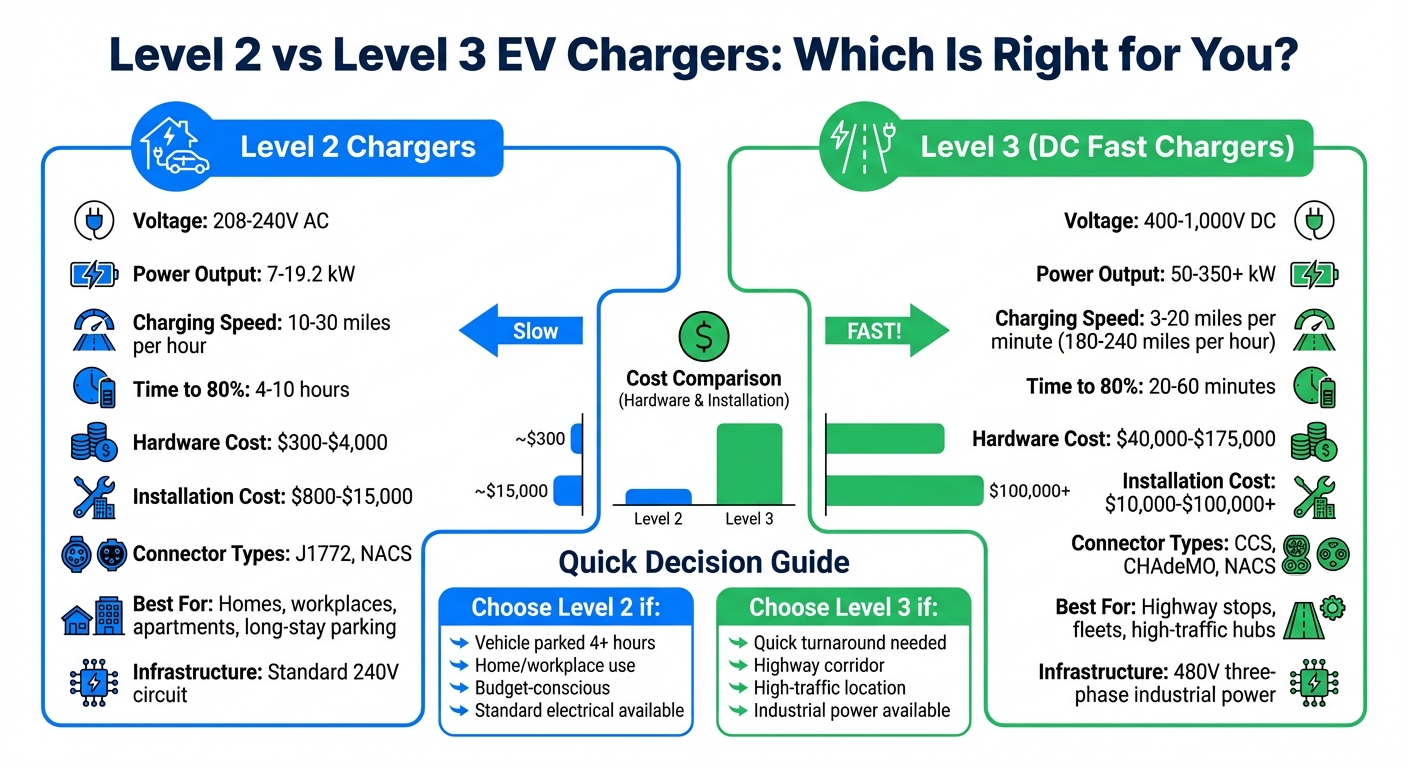
Level 2 vs Level 3 EV Chargers: Complete Comparison Guide
Level 2 chargers are commonly found in homes, workplaces, and public spaces. Operating on 208V to 240V alternating current (AC), they strike a balance between the slower Level 1 chargers, which use standard outlets, and the much faster Level 3 DC chargers. Later, we’ll compare these specifications with Level 3 chargers to help you decide which option fits your needs.
Level 2 chargers provide a power output ranging from 3.3 kW to 19.2 kW, with most delivering between 7.2 kW and 11.5 kW. This allows them to charge vehicles at a much faster pace than Level 1 chargers. For example:
In North America, the standard connector for Level 2 charging is the SAE J1772 (Type 1) plug, which includes built-in safety features for communication between the vehicle and the charger. Additionally, the J3400 connector, also known as the NACS (originally developed by Tesla), is becoming more common. Automakers like Ford, Rivian, Volvo, and Nissan are adopting it, making it easier for drivers to access diverse charging networks. This compatibility ensures a smooth installation process.
Installing a Level 2 charger requires a dedicated 240V circuit, which must be set up by a licensed electrician. The circuit breaker needs to be rated 25% higher than the charger’s power draw. For example:
Before installation, check if your electrical panel can handle the additional load. Homes with older 60-amp or 100-amp service may need to upgrade to 200-amp service to accommodate the charger.
Costs can vary widely:
Interestingly, about 88% of EV drivers with 2022 or newer vehicles use a dedicated Level 2 home charger.
Level 2 chargers shine in locations where vehicles are parked for extended periods. They’re ideal for residential garages, workplaces, multi-unit housing, and retail spaces where long-duration parking is common.
Using a Level 2 charger at home can lead to significant savings – over $1,500 per year compared to relying on public fast-charging stations. Additionally, ENERGY STAR-certified Level 2 chargers consume 40% less energy in standby mode compared to non-certified models. This is a notable advantage, as chargers typically spend about 85% of their time in standby mode.
Level 3 chargers, also known as DC Fast Chargers, are designed to deliver rapid charging speeds. Unlike Level 1 and Level 2 chargers, which supply alternating current (AC) to your vehicle, Level 3 chargers handle the conversion from AC to direct current (DC) internally before sending it directly to your car’s battery. This bypasses the vehicle’s onboard converter and allows for much faster power delivery. Because of this, you can add a significant amount of range in just a few minutes. These chargers are primarily installed in public areas like highway rest stops and busy commercial hubs, where quick charging is essential. Let’s take a closer look at the power and speed that make Level 3 chargers so effective.
Level 3 chargers operate on circuits ranging from 480 volts to 1,000 volts and deliver power outputs from 50 kW to 350 kW, with some advanced models reaching up to 400 kW. To put this into perspective, while a Level 2 charger typically adds about 15–30 miles of range per hour, a Level 3 charger can add between 3 to 20 miles of range per minute. Most EVs can reach 80% charge in just 20–30 minutes using these chargers, translating to an additional 100–200+ miles of range. However, as the battery nears full capacity, charging slows down significantly to prevent overheating or overcharging. As Ben Hsu, Editor at Autoblog, explains:
“DCFC rate slows significantly as you approach full in order to reduce the risk of overcharging the battery”.
In the U.S., common connector types for Level 3 chargers include the Combined Charging System (CCS), CHAdeMO, and the North American Charging Standard (NACS/J3400). With major automakers like Ford, Rivian, Volvo, and Nissan adopting NACS, this standard is becoming more widely available across charging networks.
Installing Level 3 chargers is no small task – it requires significant infrastructure and investment. These chargers rely on 480-volt three-phase power, which is typically found in industrial areas but is rare in standard commercial buildings. As industry expert Sam DiNello points out:
“The number one factor is the availability of the appropriate electrical infrastructure”.
The costs reflect these challenges. Basic equipment starts at around $12,500, with high-end units reaching $175,000 or more. Including infrastructure upgrades, total installation costs can climb into the hundreds of thousands of dollars. However, there is some financial relief available. The U.S. federal government offers a tax credit of up to 30% for the cost of installing commercial charging stations, capped at $30,000.
Before moving forward, businesses need to consult with electricians and utility companies to determine whether their existing electrical panels can handle the high power demands. In many cases, upgrades to the electrical service will be required, adding both time and expense. These factors help determine where Level 3 chargers are most practical and valuable.
Level 3 chargers shine in high-traffic public areas and fleet operations where fast charging is a necessity. They’re ideal for locations like highway rest stops, busy shopping centers, and fleet depots, where quick turnarounds are critical. Their infrastructure demands and costs make them less suited for residential use.
Charging fees for Level 3 stations typically range from $0.20 to $0.50 per minute, or about $10 to $20 for a substantial session. While this is more expensive than charging at home, the speed makes it worthwhile for road trips or time-sensitive situations. For businesses in high-traffic areas or those managing fleets, the ability to quickly recharge vehicles can be a game-changer.
Here’s a closer look at how Level 2 and Level 3 chargers stack up against each other. By comparing their charging speed, cost, and installation requirements, it’s easier to see how they fit into everyday life.
The standout difference is speed. Level 2 chargers use 208–240 volts AC and provide 7 kW to 19.2 kW of power, which translates to adding 10–30 miles of range per hour of charging. This makes them perfect for situations where the vehicle stays parked for extended periods – like overnight charging at home, during a work shift, or at apartment complexes.
On the other hand, Level 3 chargers, also known as DC fast chargers, operate with 400–1,000 volts DC and deliver between 50 kW and 350 kW of power. This allows them to add 3 to 20 miles of range per minute – or about 180 to 240 miles per hour. With these speeds, a Battery Electric Vehicle (BEV) can reach 80% charge in just 20 minutes to 1 hour, compared to the 4–10 hours required by Level 2 chargers.
As Courtney Lindwall from NRDC explains:
“Level 2 charging can generally charge even the biggest EV batteries overnight”.
While speed is a major factor, the financial and setup requirements also differ significantly.
When it comes to cost and installation, Level 2 chargers are the more affordable and practical option. Hardware costs for Level 2 chargers typically range from $300 to $800. For commercial-grade options, CyberSwitching’s Level 2 chargers, like the CSE1, are priced between $1,190 and $1,320, while the CSE3 (which includes a display and CTEP certification) costs $1,250 to $1,390. Installation costs vary depending on your electrical setup but usually fall between $800 and $3,000. These chargers require a standard 240-volt circuit, which is commonly found in most commercial buildings and homes.
Level 3 chargers, however, are a much larger investment. Hardware alone costs between $40,000 and $175,000 per unit, and installation costs can be even higher due to the need for 480V three-phase industrial power.
Ongoing costs also differ. Charging at home with Level 2 is roughly equivalent to paying $1.00 per gallon for gasoline. Public Level 3 charging, however, costs between $0.25 and $0.79 per kWh – or about $0.20 to $0.50 per minute. For businesses with vehicles parked overnight or during long shifts – like fleet depots or office buildings – Level 2 charging is usually sufficient and far more economical.
| Feature | Level 2 Charging | Level 3 (DC Fast Charging) |
|---|---|---|
| Voltage | 208–240V AC | 400–1,000V DC |
| Power Output | 7 kW–19.2 kW | 50 kW–350+ kW |
| Charging Speed (Range) | 10–30 miles per hour | 3–20 miles per minute |
| Time to 80% (BEV) | 4–10 hours | 20 minutes to 1 hour |
| Hardware Cost | $300–$1,390 | $40,000–$175,000 |
| Installation Cost | $800–$3,000 | Tens to hundreds of thousands |
| Infrastructure Need | Standard 240V circuit | 480V three-phase industrial power |
| Best Use Case | Overnight at home, work, long-stay parking | Road trips, high-traffic corridors, quick turnarounds |
Deciding between Level 2 and Level 3 chargers boils down to how you plan to use the charger – your specific needs will guide the best choice. Below, we break down the options based on different scenarios.
For residential use, Level 2 chargers are the go-to option. These chargers connect to a standard 240-volt circuit, making use of existing electrical setups. Since cars typically remain parked overnight (8 to 12 hours), Level 2 chargers can fully charge most batteries in 4 to 10 hours, making them a practical choice for homeowners. On the other hand, Level 3 chargers require industrial-grade power (480 to 1,000 volts), which most residential buildings simply don’t have. Plus, frequent use of DC fast charging can strain battery health over time.
As Jered Korfhage from MotorTrend explains:
“Installing a Level 2 EV charger at home appears to be the best solution to keeping EVs and PHEVs charged, especially when the vehicles are parked overnight.”
For apartment complexes, Level 2 chargers are also a smart choice. Features like RFID or mobile app authentication simplify access control and help property managers recover costs. Many systems even offer dynamic load management, allowing multiple chargers to share a single circuit, which avoids costly electrical upgrades.
When it comes to commercial spaces, dwell time – the length of time vehicles are parked – is a critical factor. Level 2 chargers work well for workplaces, hotels, hospitals, and shopping centers where cars are parked for several hours. In fact, over 80% of public EV chargers in the U.S. are Level 2.
However, for high-traffic areas like highway rest stops, gas stations, and quick-service retail outlets, Level 3 chargers are more appropriate. These chargers can replenish an EV’s battery in just 20 to 30 minutes, making them ideal for drivers who need to get back on the road quickly.
Sam DiNello, CEO of Future Energy, highlights the importance of infrastructure:
“The number one factor is the availability of the appropriate electrical infrastructure.”
For businesses, a phased approach often works best: start with Level 2 chargers to meet current demand, and plan for future Level 3 installations as infrastructure and demand grow.
Fleet operators have distinct charging needs, largely depending on vehicle usage patterns. For fleets parked overnight at depots, Level 2 chargers are a cost-effective and practical solution. Charging at a private depot has been likened to fueling a gas vehicle at about $1.00 per gallon. Additionally, Level 2 charging is gentler on batteries, making it suitable for daily use.
On the flip side, fleets that need rapid mid-shift charging – especially heavy-duty vehicles running multiple shifts – should consider Level 3 chargers. These chargers provide 180 to 240 miles of range per hour, making them ideal for operations where time is critical. However, their high upfront costs ($40,000 to $175,000 per unit) mean they’re only worth the investment when operational needs justify it.
Future Energy advises:
“If your EV fleet will be stationary overnight, level 2 charging solutions may be sufficient.”
Fleet managers can also benefit from dynamic load management software to manage charging during peak utility hours. RFID cards or access badges are another useful tool for tracking energy usage and controlling costs.
Here’s a closer look at the key differences between Level 2 and Level 3 EV chargers:
| Feature | Level 2 Charger | Level 3 (DC Fast Charger) |
|---|---|---|
| Power Type | Alternating Current (AC) | Direct Current (DC) |
| Voltage | 208V–240V | 400V–1,000V |
| Power Output | 7 kW–19.2 kW | 50 kW–500 kW |
| Charging Speed | 10–32 miles range per hour | 180–240 miles range per hour |
| Time to 80% Charge | 4–10 hours | 20–60 minutes |
| Connector Types | J1772 | CCS, CHAdeMO, NACS (Tesla) |
| Hardware Cost | $300–$4,000 | $40,000–$175,000 |
| Installation Cost | $400–$15,000 | $10,000–$100,000+ |
| Weight | Lightweight (wall-mountable) | 500+ pounds |
| Best Use Case | Homes, workplaces, apartments | Highway corridors, fleets, high-traffic hubs |
| Grid Requirements | Standard 240V circuit | 480V three-phase industrial power |
| Battery Protection | Consistent, gentle charging | Charging speed reduces after 80% to protect battery health |
This table can help you decide which charger fits your needs, whether it’s for home use, workplace charging, or supporting a busy highway station.
Deciding between Level 2 and Level 3 EV chargers comes down to two key factors: how long vehicles typically remain parked and the available electrical infrastructure. For places like workplaces, apartment buildings, or hotels – where vehicles are parked for several hours – Level 2 chargers are a practical choice. These chargers use standard 208V–240V power, commonly found in commercial buildings, and avoid the hefty utility upgrades often required for Level 3 setups. On the other hand, Level 3 chargers are ideal for highway corridors or locations with high turnover, where drivers need a quick charge and can be back on the road in about an hour.
For commercial use, CyberSwitching’s Level 2 chargers strike a great balance between affordability and performance. The equipment costs range from $2,790 to $4,090, with installation expenses falling between $5,000 and $15,000. Compare that to Level 3 hardware, which can cost anywhere from $40,000 to $175,000. A standout feature of CyberSwitching’s chargers is their dynamic load management capability, which allows multiple chargers to operate on existing electrical panels without causing peak utility rate hikes or requiring expensive upgrades. With over 5,000 commercial chargers installed across 47 states and an industry-leading one-week lead time, CyberSwitching offers a straightforward path to getting started. Their chargers also come equipped with revenue collection options like Apple Pay and Google Pay, RFID support for access control, and OCPP compliance for seamless system integration.
When making your decision, it’s essential to assess your site’s power capacity and typical vehicle dwell times. If 480V three-phase power isn’t already available, the costs for Level 3 infrastructure can be prohibitive. Starting with Level 2 chargers can address immediate needs while leaving room to consider Level 3 upgrades in the future as requirements grow.
When choosing between a Level 2 and Level 3 EV charger, the key factors to weigh are charging speed, cost, and how you plan to use it.
Level 2 chargers are great for daily use at home, work, or public spaces. They can charge most EVs to 80% in about 4–10 hours and are relatively affordable to install. All you need is a standard 240V outlet, making them a convenient option for residential settings or places where vehicles can remain plugged in for several hours.
Level 3 chargers, often called DC fast chargers, work much faster – charging an EV to 80% in just 20–30 minutes. However, they come with steep installation costs and require specialized infrastructure. Because of this, they’re typically found in high-traffic areas like highway rest stops or used in commercial settings where quick charging is essential, such as for fleets or long-distance travel.
Think about your needs: If you’re looking for an economical option for overnight or extended charging, Level 2 is likely the way to go. On the other hand, if speed is a priority – whether for road trips, busy commercial locations, or fleet operations – Level 3 chargers might be worth the investment.
The costs and setup requirements for Level 2 and Level 3 EV chargers differ significantly due to their power demands and the infrastructure they need.
Level 2 chargers run on 240V and are generally compatible with standard residential and commercial electrical systems. Installing them is relatively simple, often involving the addition of a dedicated circuit (with a breaker ranging from 20A to 60A) and minimal updates to the existing electrical panel. Depending on factors like location and complexity, installation costs can range anywhere from a few hundred to a few thousand dollars.
On the other hand, Level 3 chargers, also known as DC fast chargers, operate at much higher power levels – starting at 50 kW or more. These chargers require specialized infrastructure, including a high-capacity electrical supply and substantial system upgrades. Their installation is far more complex and may even involve structural changes to accommodate the equipment. As a result, installation costs can soar from several thousand to tens of thousands of dollars, making them a better fit for commercial or public spaces rather than homes.
Level 3 chargers, or DC fast chargers, are not a practical choice for most residential setups due to their intense power demands. These chargers require a robust electrical infrastructure that the majority of homes simply don’t have. To install one, you’d likely need to make extensive (and expensive) upgrades to your home’s electrical system, turning it into a complex and costly endeavor.
On top of that, Level 3 chargers are primarily built for high-traffic locations, such as commercial properties or public charging stations, where quick charging is a necessity. For personal use, a Level 2 charger usually does the job well, striking a good balance between cost, charging speed, and straightforward installation.